
Saju, Palja and Myeongri: Are They the Same Thing?
Three words that often get used interchangeably, but each points to something slightly different. Following an encyclopedia's example of how the year, month, day and hour of birth are written as eight characters, we sort out how the three words relate.

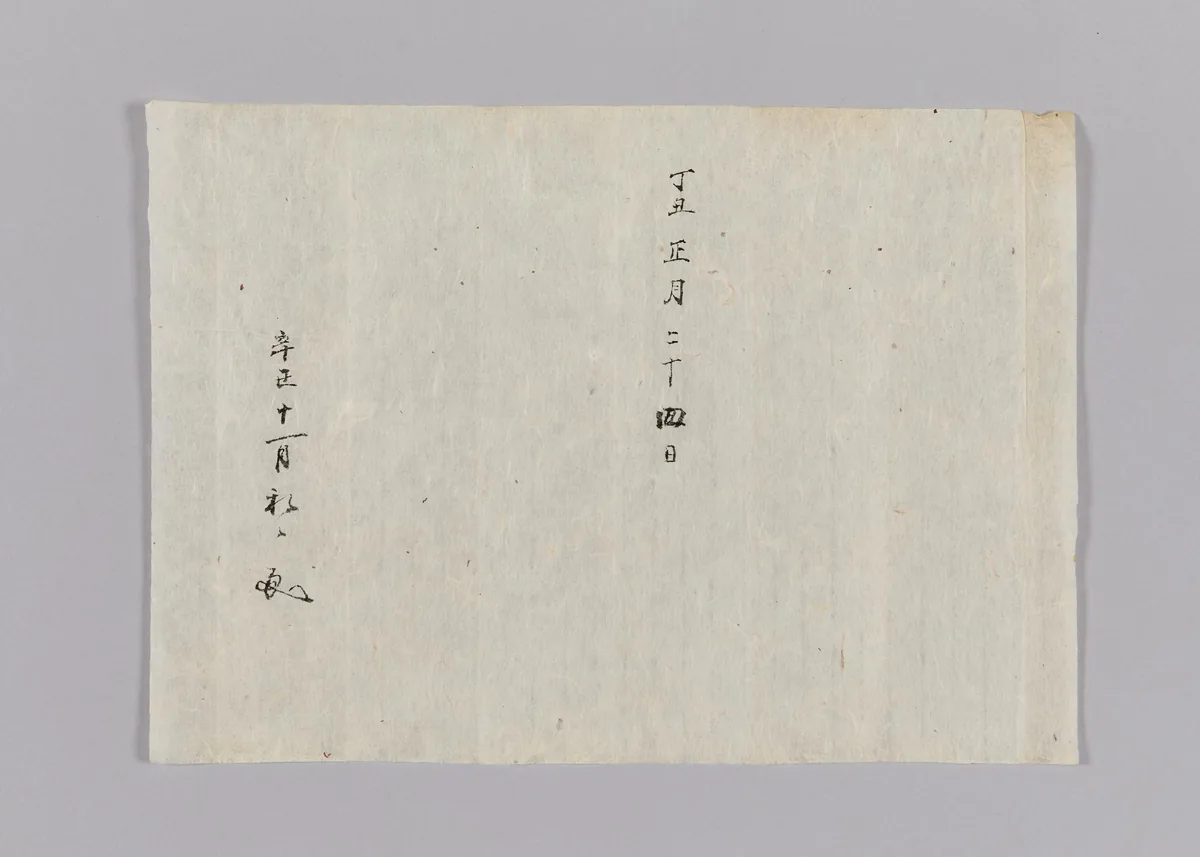
Yecheon Museum (예천박물관) · "Saju Danja of the Sinsa Year" (Donation 12160) · Original · KOGL Type 1 · Resized for display only · Center crop for sharing
On this page
"Getting your Saju read," "having a tough palja," "studying myeongri." All three are familiar phrases in Korean, but each points to something slightly different. I'll first sort out how the three relate in a single table, then follow how the eight characters that make up a Saju are put together.
Before that, one distinction. Going to a shrine for a spirit-guided divination or holding a gut ritual belongs to Korean shamanism, musok. It is a religious tradition centered on spirits and mudang, Korea's shamans. Saju is a system that writes the year, month, day and hour of birth as characters and reads them by weighing the relations between those characters. Some people practice both, but the principles are different. The shamanic side is covered in the piece on the meaning and history of mansin; here we deal only with the side that calculates.
The whole picture first
| Term | What it refers to | One-line example |
|---|---|---|
| Saju (四柱) | The year, month, day and hour of birth: four pillars | "Setting up a Saju" = finding the four pillars |
| Palja (八字) | The eight characters that make up the four pillars | Two characters per pillar, eight in all |
| Saju palja | The two words combined; in everyday speech it also means "the fate you were born with" | "It's just my palja" |
| Myeongri (命理), myeongrihak | A traditional system that interprets a person's tendencies and the flow of fortune from the structure of the eight characters | "Let's read it through myeongri" |
The Encyclopedia of Korean Culture entry "Saju" defines Saju as "the year, month, day and hour of birth, identified in order to divine a person's fortune and misfortune." The same entry explains that the name comes from seeing a person as a house and calling the year, month, day and hour that house's four pillars (柱). Since each pillar is written with two characters, eight in all, it is also called palja, "eight characters." The view that a Saju set up this way holds that person's fortune is called myeongri (命理), and analyzing the structure of a Saju to infer fortune and misfortune is called chumyeong (推命). What people usually mean by "getting a Saju read" is exactly this chumyeong.
To sum up, Saju and palja count the same thing either as four pillars or as eight characters, and myeongri is the method of reading those eight characters. Once you have this distinction down, the pieces that follow get much less confusing.
How far does the house metaphor hold?
The four-pillar metaphor is quite useful. If you don't know your hour of birth, you can't set up the Hour Pillar, so only three pillars remain. Picture a house missing one pillar, and you can see at once what is empty.
But the metaphor has one gap. A house's four pillars usually share the load equally, but in myeongri, the four pillars are not equal. The pillar of the day you were born, and in particular its upper character, becomes the reference point for interpretation. That character is called the Day Master, ilgan (日干). I'll come back to it in the example below.
What are the eight characters made of?
Each pillar is a pair of an upper character and a lower character. On top goes one of the ten Heavenly Stems, cheongan (天干); below goes one of the twelve Earthly Branches, jiji (地支).
The 10 Heavenly Stems
The Heavenly Stems pair up by the Five Elements (五行, the five categories Wood, Fire, Earth, Metal and Water) and by yin and yang.
| Element | Yang (陽) | Yin (陰) |
|---|---|---|
| Wood (木) | Gap (甲) | Eul (乙) |
| Fire (火) | Byeong (丙) | Jeong (丁) |
| Earth (土) | Mu (戊) | Gi (己) |
| Metal (金) | Gyeong (庚) | Sin (辛) |
| Water (水) | Im (壬) | Gye (癸) |
The 12 Earthly Branches
The Earthly Branches are the twelve characters familiar from the zodiac animals. In Saju, though, each character's element, season and hour matter more than the animal. The hours in the table below are the traditional hours (sibisi), which divide the day into twelve two-hour periods.
| Branch | Animal | Element | Yin/yang | Hours |
|---|---|---|---|---|
| Ja (子) | Rat | Water | Yang | 23–01 |
| Chuk (丑) | Ox | Earth | Yin | 01–03 |
| In (寅) | Tiger | Wood | Yang | 03–05 |
| Myo (卯) | Rabbit | Wood | Yin | 05–07 |
| Jin (辰) | Dragon | Earth | Yang | 07–09 |
| Sa (巳) | Snake | Fire | Yin | 09–11 |
| O (午) | Horse | Fire | Yang | 11–13 |
| Mi (未) | Goat | Earth | Yin | 13–15 |
| Sin (申) | Monkey | Metal | Yang | 15–17 |
| Yu (酉) | Rooster | Metal | Yin | 17–19 |
| Sul (戌) | Dog | Earth | Yang | 19–21 |
| Hae (亥) | Pig | Water | Yin | 21–23 |
The yin and yang in the table are simply assigned to the twelve characters in alternating order. In actual readings, a widely used view switches ja and o to yin and sa and hae to yang according to their function (cheyong, "substance and function"). The hours, too, have another convention. Because Korea Standard Time is out of step with the sun's actual position, the boundaries are pushed back by 30 minutes, so that 23:30 to 1:30 counts as the hour of the Rat (jasi).
10 times 12, so why 60?
Pair 10 Heavenly Stems with 12 Earthly Branches, and you might expect 120 combinations, but there are actually 60. Starting from gapja (甲子), then eulchuk, byeongin and so on, the two rows advance one step together. The stems return to the start every 10 steps and the branches every 12, so the two rows come back to the start together only at the 60th step, the least common multiple of 10 and 12.
Advancing this way, some pairs never meet. The first stem, gap, meets the first branch, ja, and from then on only ever meets odd-numbered branches. That is why there is no pillar called gapchuk. In terms of the two tables above, yang stems pair only with yang branches, and yin stems only with yin branches. These 60 are the sexagenary cycle, yuksipgapja, and every one of the four pillars of a Saju is written as one of them.
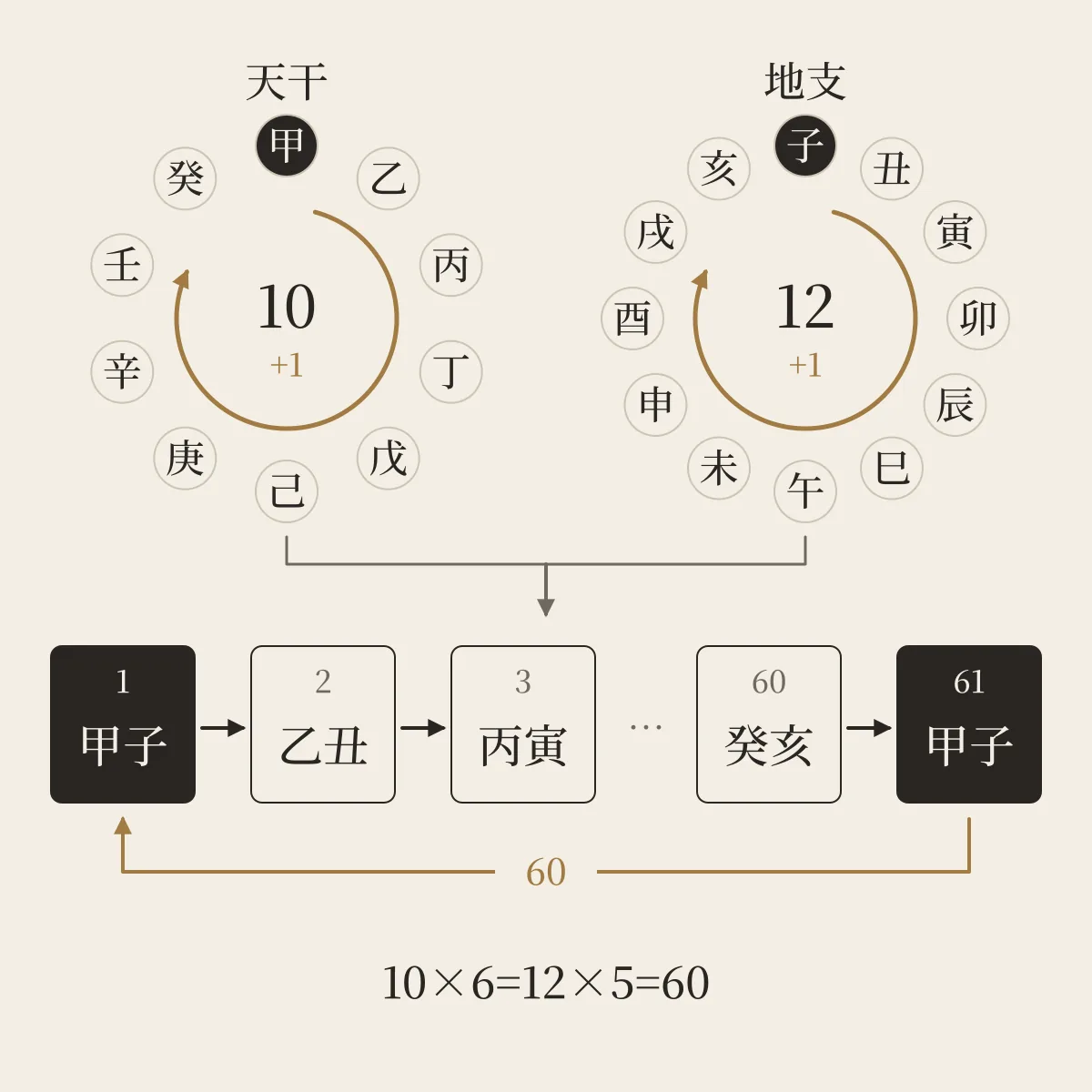
Diagram · Order reference: Hong Kong Observatory, "Heavenly Stems and Earthly Branches"
The four pillars in an example
Below is the example the encyclopedia's "Saju" entry uses to explain how to set up a Saju. It is not the chart (myeongsik, 命式, a table recording a Saju) of any particular person.
Example: August 25, 1911 (solar calendar), 6 p.m.
| Pillar | What it represents | Stem | Branch | Pillar name |
|---|---|---|---|---|
| Year Pillar (年柱) | Year of birth | Sin (辛) | Hae (亥) | Sinhae |
| Month Pillar (月柱) | Month of birth | Byeong (丙) | Sin (申) | Byeongsin |
| Day Pillar (日柱) | Day of birth | Jeong (丁) | Myo (卯) | Jeongmyo |
| Hour Pillar (時柱) | Hour of birth | Gi (己) | Yu (酉) | Giyu |
The eight characters are 辛, 亥, 丙, 申, 丁, 卯, 己, 酉. As mentioned earlier, in all four pillars yang pairs with yang and yin with yin. Of these, jeong (丁), the upper character of the Day Pillar, is the Day Master. The encyclopedia entry calls the Day Master gisin (己身), "oneself," and explains that this character is placed at the center to examine its relations with the other seven. It is a different word from the myeongri term gisin (忌神), which sounds the same. This is what I meant earlier when I said the four pillars are not equal.
How are zodiac animals, dangsaju and spirit divination different?
Let's also go over a few words often mixed up with Saju.
- Your zodiac animal is one of the eight characters: the branch of the Year Pillar. In the example, that is hae (亥), the Pig. Since it is one of eight characters, the zodiac animal alone cannot speak for the whole Saju.
- Dangsaju (唐四柱) has a similar name but a different method. The entry on dangsaju explains that while ordinary Saju looks at the generating and controlling relations of the stems and branches and the strength of the Five Elements, dangsaju judges fortune by how twelve stars believed to be in the heavens meet.
- Spirit divination and gut belong to the realm of Korean shamanism, which we set apart at the start. Their roots differ from Saju, which weighs characters.
What does myeongri look at?
According to the encyclopedia entry, myeongri places the Day Master at the center and looks at several relations together. Put into plain words, the list in the entry goes like this:
| What it looks at | Plain explanation |
|---|---|
| Harmony of yin and yang | Whether the yang and yin characters lean to one side |
| Generation and control of the Five Elements (生剋) | Whether the five forces help or hold each other down |
| Combination (合) and clash (冲) | Characters binding together or colliding |
| Yukchin (六親) | A classification likening relations with the Day Master to family and social relations |
| Daeun (大運) and se-un (歲運) | Flows believed to change in 10-year and 1-year units |
The same entry notes that Saju "values balance and harmony above all." It means not drawing a conclusion from one character or one force but looking at the whole structure together. With this much to look at, the same eight characters can lead to different conclusions depending on the reader and the school.
The encyclopedia also offers a clue as to where this method of weighing the Five Elements came from. The entry on dangsaju explains that Xu Ziping (徐子平) added the generation and control of the stems, branches and Five Elements to the method of Li Xuzhong (李虛中) of the Tang dynasty, who judged fortune from the year, month, day and hour of birth, and that the practice later developed into two branches, dangsaju and Saju. As we saw, ordinary Saju is the side that looks at the relations of stems, branches and the Five Elements, and dangsaju is the side that looks at the twelve stars. Xu Ziping's name also appears in the title of the myeongri book Yuanhai Ziping (淵海子平).
Saju in daily life and institutions
Saju did not stay inside calculation tables. It was long used for life's big events, such as marriage. According to the encyclopedia's entry on betrothal, among ordinary people in traditional society, when a match proposed through a go-between suited both families, the marriage was promised either by the heads of the two households meeting or by sending the Saju. The entry calls the Saju at that point "a token of the marriage promise." Before anyone weighed fortune from the Saju they received, sending the Saju was itself the promise.
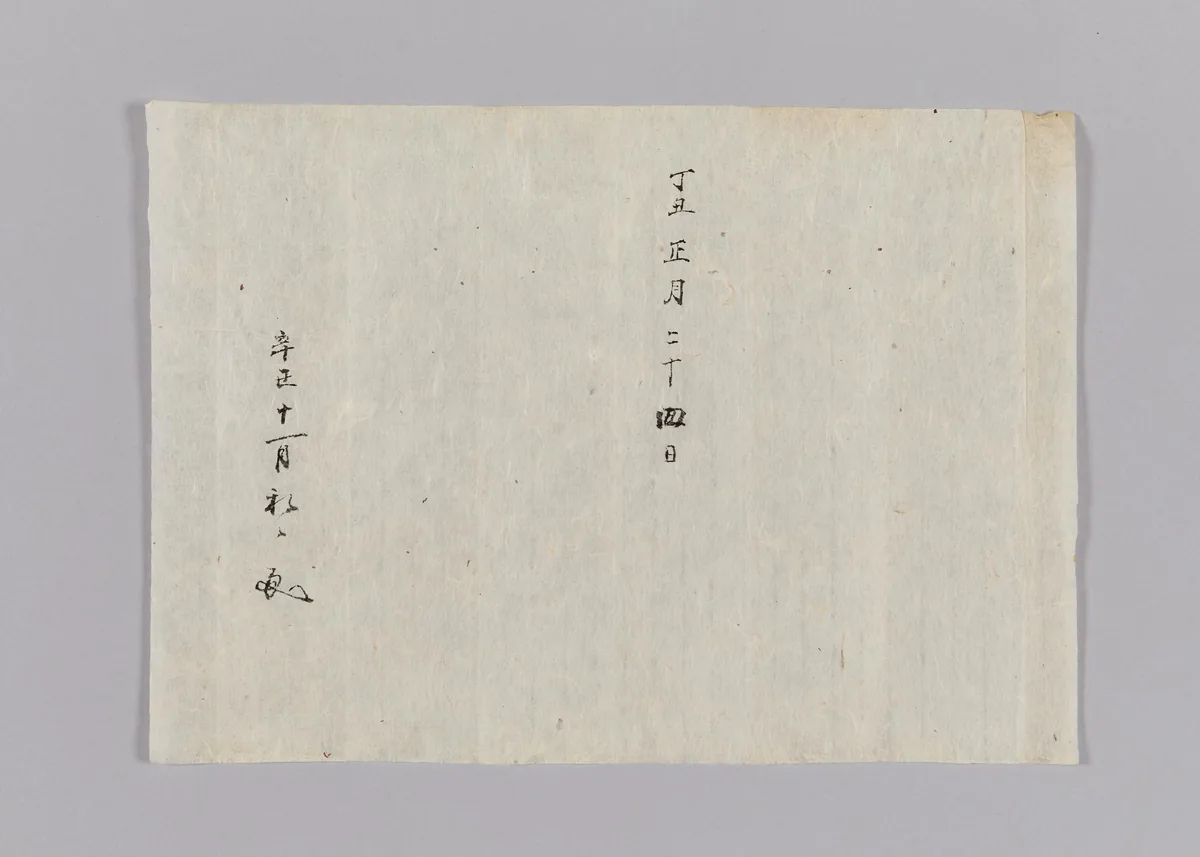
Yecheon Museum (예천박물관) · "Saju Danja of the Sinsa Year" (Donation 12160) · Original · KOGL Type 1 · Resized only
Choosing times by the stems and branches also had a place inside state institutions. The Gwansanggam, Joseon's office of astronomy and related sciences, had a division of myeonggwahak (命課學) alongside astronomy and geography. According to the entry on myeonggwahak, myeonggwahak was in charge of choosing auspicious dates and hours for royal and court events, and its officials were selected through the eumyanggwa (陰陽科) state examination. In the final round (boksi) of the regular and special examinations, only two places were allotted to myeonggwahak, so the door was quite narrow. This work was not the same as today's personal Saju consultations. Still, it shows that the idea of choosing times by stems, branches and dates had a place within state institutions.
Traditional explanations and verified facts
Up to here, we have followed how the traditional system of myeongri sees itself working. This blog does not treat Saju as a verified method for predicting personality or future events. The encyclopedia's entry on unsu (fortune), too, explains that the idea of fortune had its own rational structure within the natural philosophy handed down in East Asia, but that its foundation differs from the scientific rationalism established in the West in the 18th century with the development of classical mechanics and the natural sciences.
So this is as far as I'd suggest taking Saju:
- Use it as material for conversations that help you sort out your situation from a different angle.
- For decisions with big consequences, such as health, investments or legal matters, check with experts in those fields.
- Don't pin yourself or others down with phrases like "a bad Saju" or "your fate is sealed."
Sources
- Academy of Korean Studies, Encyclopedia of Korean Culture (한국민족문화대백과사전): Saju, Dangsaju, Unsu, Myeonggwahak (Gwansanggam), Betrothal
- Korean Wikipedia, Jiji (calendar) — used to check the zodiac animal, element, yin/yang and hour of each Earthly Branch