
Reading a Manseryeok: Where Do You Start?
A manseryeok is a calendar that gives each day a name such as 'gapja' or 'eulchuk.' We break down how to find the four pillars of a Saju in it into five steps, and go over the rules that confuse first-time readers, such as the Year Pillar changing at Ipchun rather than on Lunar New Year.

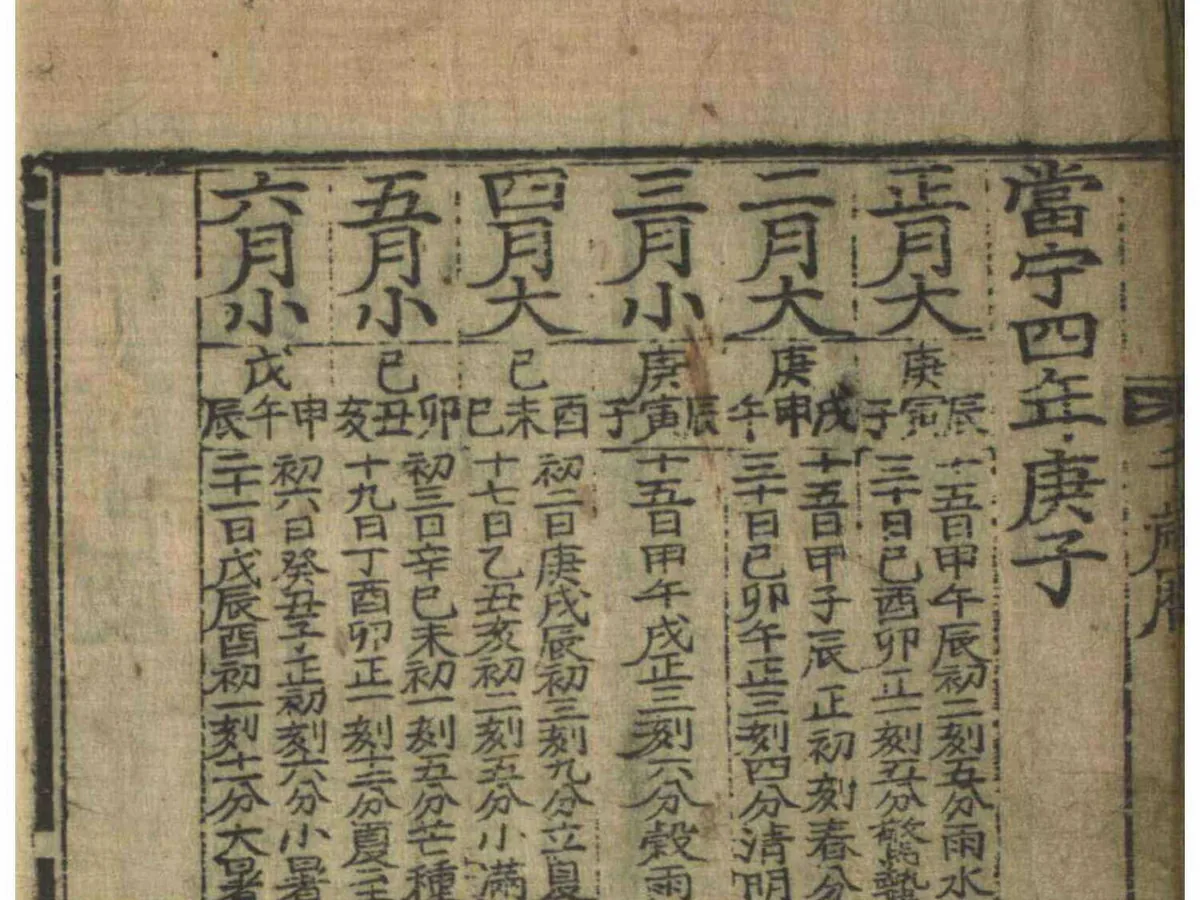
Digitized by the National Library of Korea · Cheonseryeok (千歲曆) (1782, Gwansanggam) · Original · Public domain · Partly cropped, resized
On this page
A manseryeok (萬歲曆) is a calendar that gives the stem-branch name (ganji, 干支) of every date. It is the basic tool you open to find the four pillars of a Saju. The first time you open one, it is packed with numbers and Chinese characters and you don't know where to look, but once you fix the order, there are fewer places to look than you'd think. Starting with getting your birth information in order, through finding the Day Master (ilgan, 日干), to finding all four pillars, let's go through it in five steps.
If Saju, palja and the Heavenly Stems and Earthly Branches are still unfamiliar, it helps to read the piece on Saju, palja and myeongri first.
The manseryeok began as a state almanac
Let's start with the name. According to the Encyclopedia of Korean Culture entry "Cheonseryeok", in 1782 King Jeongjo ordered the Gwansanggam, the royal office of astronomy, to produce the Cheonseryeok (千歲曆, "thousand-year calendar"), which calculated the calendar for the 100 years from 1777 in advance. Every time ten years passed, the next ten years were to be calculated and added, which spared the calendar officials the trouble of making corrections as they went.
This book is the forerunner of the manseryeok. The Gwansanggam produced a sequel in 1864, and in 1904 the name Cheonseryeok was changed to Manseryeok ("ten-thousand-year calendar"). From a thousand years to ten thousand: at least the name grew tenfold.
For each year, the Cheonseryeok recorded whether each lunar month was long or short, the dates and times of the 24 solar terms, and the stem-branch names of the 1st, 11th and 21st of every month. A day's stem-branch name advances one step a day in the order of the sexagenary cycle, so if you know the names of those three days, you can find the rest by counting in order. What we look for in a manseryeok today comes down to exactly this: the stem-branch name of each date and the times of the solar terms. The entry "Saju" also notes that because the rules for setting up a Saju are cumbersome, people commonly use a manseryeok.
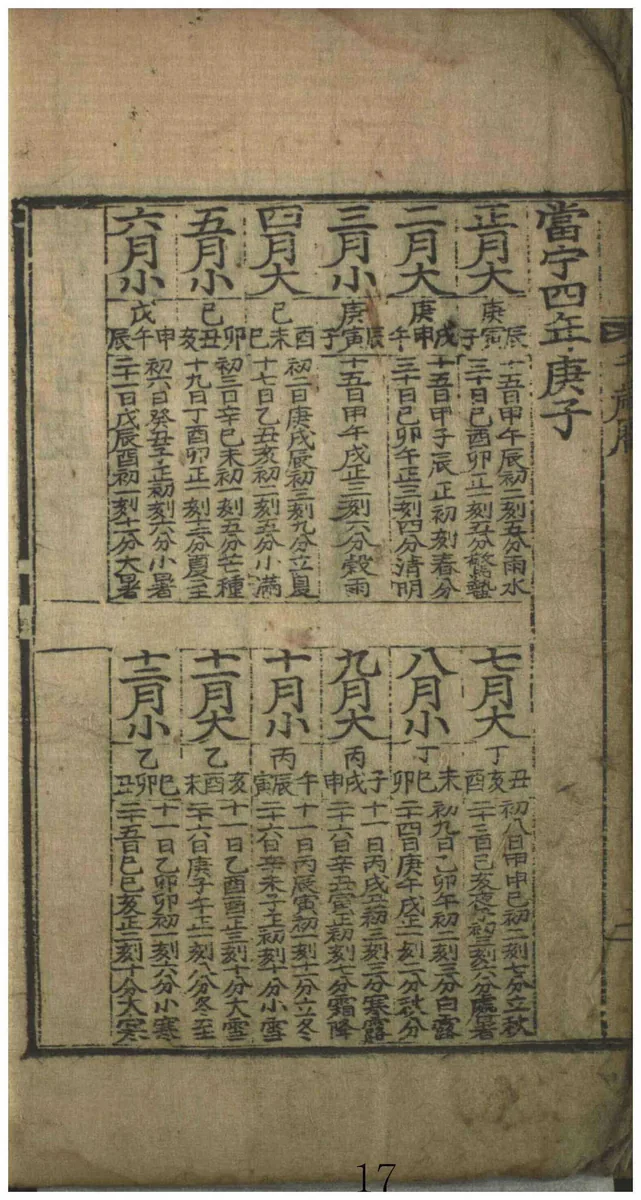
Digitized by the National Library of Korea · Cheonseryeok (千歲曆) (1782, Gwansanggam) · Original · Public domain
Information to prepare first
| Information | Why it's needed | What to check |
|---|---|---|
| Date of birth | To find the Year, Month and Day Pillars | Solar or lunar; if lunar, whether it was a leap month |
| Time of birth | To find the Hour Pillar; on a boundary day it affects other pillars too | If unknown, leave it as "unknown," and first check whether a solar term changed that day |
| Place of birth | Some methods correct for local time differences | At least note whether it was in Korea or abroad |
The time of birth often depends on memory. If you can confirm it from a birth record, use that time; if that's hard, leave the Hour Pillar blank. In most cases, even with the Hour Pillar empty, the Year, Month and Day Pillars can be used as they are.
There are two exceptions. If you were born on the day of Ipchun (Start of Spring) or another solar-term change, not knowing the time alone may keep you from settling on a single Year or Month Pillar. The same goes for the Day Pillar if you use a method that changes the day when the Rat hour begins (tongjasi): if you might have been born between around 11 p.m. and midnight, the next day's Day Pillar remains a possibility. Both are covered below under "Days that sit on a boundary." Either way, a time filled in by guesswork leaves more confusion than a blank.
The order: five steps
| Step | What you do | Rule |
|---|---|---|
| 1 | Align the date with the manseryeok | If your birthday is lunar, convert it to solar and check for a leap month |
| 2 | Find the Year Pillar | The year changes at Ipchun, not on Lunar New Year |
| 3 | Find the Month Pillar | The month changes at the moment a solar term begins, not on the 1st |
| 4 | Find the Day Pillar and Day Master | Copy that day's iljin (日辰) and write its upper character down as the Day Master |
| 5 | Find the Hour Pillar | Attach the stem set by the Day Master to the branch of your birth hour |
There is a reason for this order. The stem of the Month Pillar is set by looking at the stem of the Year Pillar, and the stem of the Hour Pillar is set by looking at the Day Master. If checking the Day Master were the last step, you would have to come back once while finding the Hour Pillar. So I put the Day Master before the Hour Pillar.
Step 1: Align the date
Start by settling on one standard for the date. If you only know your lunar birthday, first find what solar date it falls on. In a year with a leap month, a lunar month with the same number comes twice, so the date shifts by about a month depending on whether you were born in the leap month. If it's a lunar birthday passed down in your family, check the leap month too.
Step 2: The Year Pillar changes at Ipchun
The entry "Saju" explains that in fortune-telling practice, the new year begins at Ipchun. Even after Lunar New Year, if it's before Ipchun, the Year Pillar is taken from the old year; conversely, even before Lunar New Year, if Ipchun has passed, it's taken from the new year. The entry's example makes it clear. Ipchun of 1920 (the gyeongsin year) fell on the 16th day of the 12th lunar month of the previous year, so a person born on lunar December 16, 1919, has a Saju of the gyeongsin year, not the gimi year.
The entry "Ipchun" gives Ipchun as the moment the sun reaches an ecliptic longitude of 315 degrees, around February 4 in the solar calendar. The word "around" is there for a reason: the date and time shift a little every year. It may be the most honest word on the calendar.
Step 3: The Month Pillar changes with the solar terms
According to the entry "Jeolgi" (solar terms), the 24 solar terms are reference points that divide the sun's ecliptic longitude into 15-degree steps; counting from Ipchun, the odd-numbered ones are called jeol (節) and the even-numbered ones jung (中). The months of a Saju change at the moment one of the jeol begins.
| Month branch | Starting solar term | Solar date, around |
|---|---|---|
| In (寅) | Ipchun (Start of Spring) | Feb 4 |
| Myo (卯) | Gyeongchip (Awakening of Insects) | Mar 6 |
| Jin (辰) | Cheongmyeong (Clear and Bright) | Apr 5 |
| Sa (巳) | Ipha (Start of Summer) | May 6 |
| O (午) | Mangjong (Grain in Ear) | Jun 6 |
| Mi (未) | Soseo (Minor Heat) | Jul 7 |
| Sin (申) | Ipchu (Start of Autumn) | Aug 8 |
| Yu (酉) | Baengno (White Dew) | Sep 8 |
| Sul (戌) | Hallo (Cold Dew) | Oct 8 |
| Hae (亥) | Ipdong (Start of Winter) | Nov 7 |
| Ja (子) | Daeseol (Major Snow) | Dec 7 |
| Chuk (丑) | Sohan (Minor Cold) | Jan 6 |
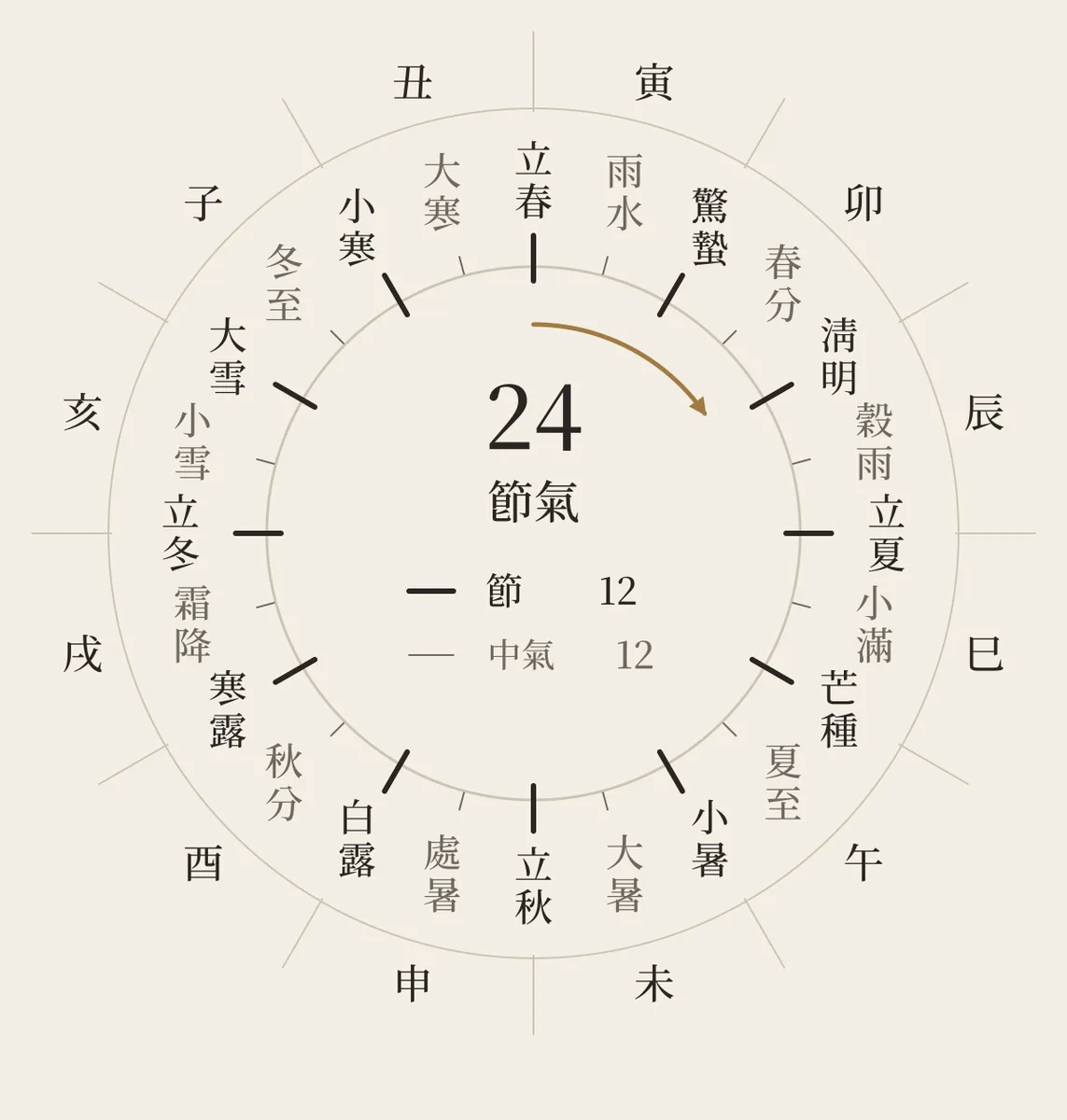
Diagram · Jeol/jung distinction based on: Encyclopedia of Korean Culture, "Jeolgi"
The stem of the Month Pillar depends on the stem of the Year Pillar. This rule is called woldubeop (月頭法). In the table below, find the Month Pillar of the in month (寅月), the first month of each year, and from the next month on, just advance one step at a time in the order of the sexagenary cycle.
| Year stem (年干) | Month Pillar of the in month |
|---|---|
| Gap, gi | Byeongin (丙寅) |
| Eul, gyeong | Muin (戊寅) |
| Byeong, sin (辛) | Gyeongin (庚寅) |
| Jeong, im | Imin (壬寅) |
| Mu, gye | Gabin (甲寅) |
Step 4: Copy the Day Pillar and write down the Day Master
There is nothing to calculate for the Day Pillar. As the entry "Saju" explains, every day has a fixed iljin regardless of the year or solar term, so you simply copy the iljin of your birth date from the manseryeok. But if you were born between 11 p.m. and midnight, the Day Pillar can differ depending on where you put the boundary between dates. That case is covered below under "Days that sit on a boundary."
Once you've copied the Day Pillar, write its upper character down separately. That character is the Day Master. It is the reference point for interpretation, and you'll use it in the very next step to find the Hour Pillar.
Step 5: The Hour Pillar is set by the Day Master
The branch of the hour is set by the sibisi, the twelve two-hour periods: the Rat hour (23–01), the Ox hour (01–03) and so on. The stem of the Hour Pillar depends on the Day Master, and this rule is called sidubeop (時頭法).
There is also a method that pushes each hour boundary back by 30 minutes, treating the Rat hour as 23:30 to 1:30 (bansi). It is meant to make up for the gap between standard time and the sun's position, discussed below. Check once which approach the manseryeok you use follows.
| Day Master (日干) | Hour Pillar of the Rat hour |
|---|---|
| Gap, gi | Gapja (甲子) |
| Eul, gyeong | Byeongja (丙子) |
| Byeong, sin (辛) | Muja (戊子) |
| Jeong, im | Gyeongja (庚子) |
| Mu, gye | Imja (壬子) |
Following an example
Let's follow, in the five-step order, the example the entry "Saju" uses for explanation. It is not the chart of any particular person.
Example: August 25, 1911 (solar calendar), 6 p.m.
| Step | Reasoning | Result |
|---|---|---|
| 1 Date | It's a solar date, so use it as is | August 25, 1911 |
| 2 Year Pillar | It's August, so that year's Ipchun has already passed. 1911 is a sinhae year | Sinhae (辛亥) |
| 3 Month Pillar | It's between Ipchu (around Aug 8) and Baengno (around Sep 8), so it's the sin month (申月). The year stem is sin (辛), so the in month starts with gyeongin, and in the order gyeongin → sinmyo → imjin → gyesa → gabo → eulmi → byeongsin it's the seventh month | Byeongsin (丙申) |
| 4 Day Pillar and Day Master | Find that day's iljin in the manseryeok. The upper character is the Day Master | Jeongmyo (丁卯), Day Master jeong (丁) |
| 5 Hour Pillar | 6 p.m. is the Rooster hour (17–19). The Day Master is jeong (丁), so the Rat hour starts with gyeongja, and in the order gyeongja → sinchuk → imin → gyemyo → gapjin → eulsa → byeongo → jeongmi → musin → giyu it's the tenth hour | Giyu (己酉) |
The four pillars found this way match the sinhae, byeongsin, jeongmyo and giyu given in the encyclopedia entry.
Days that sit on a boundary
The five steps work as they are for most dates. But if you were born close to a boundary, you need to check the items below separately. Each has a long enough story to need a piece of its own, so here I'll only note what to check.
For each case, I've also noted whether it's a calculation with a correct answer or a question of choosing a method.
- Born on the day of Ipchun or another solar term (a calculation with a correct answer): Compare the time that solar term began with your time of birth. Going by the date alone, you could be a month off, or a year off in the case of Ipchun. If you don't know your time of birth, note both possibilities.
- Born between 11 p.m. and midnight, or possibly in that window because the time is unknown (a choice of method): See whether the method changes the day when the Rat hour begins (tongjasi), or splits the Rat hour around midnight and assigns births before midnight to that day's Day Pillar (yajasi and jeongjasi; jeongjasi is also called jojasi). The entry "Saju" introduces the latter. A birth after midnight gets that date's Day Pillar under either method.
- Born in a period when standard time changed or daylight saving time was in use (a calculation with a correct answer): Work out which standard the clock behind the time on the birth record followed at that point.
- Born far from the reference meridian (a choice of method): Check whether the method corrects for local time differences.
Let me add a little about standard time. The National Archives of Korea's record on daylight saving time explains that 12 noon on our clocks today is not literally noon: the sun reaches its midday point some 30 minutes later. The reference meridian of Korea Standard Time has also changed several times. Just knowing that the time on the clock and the sun's position don't always match gives you a sense of why these checks are needed.
There is a reason I split the cases into "a calculation with a correct answer" and "a choice of method." When two manseryeok give different results, if a calculation is wrong, one of them has to be fixed. If the methods differ, it's not a question that has been settled in favor of one side; they've simply taken different paths.
The manseryeok is a calculation tool
What a manseryeok tells you is how dates correspond to stem-branch names. Finding the four pillars is a matter of astronomical calculation and fixed rules, so if you calculate accurately and choose the same method, anyone will get the same result. The interpretation that follows belongs to the traditional system of myeongri. An accurate calculation does not make the interpretation accurate too.
Here is the order once more. Align the date, set the year by Ipchun and the month by the solar terms, copy the iljin and write down the Day Master, and use that Day Master to attach the Hour Pillar. Days that sit on a boundary get checked separately.
Sources
- Academy of Korean Studies, Encyclopedia of Korean Culture (한국민족문화대백과사전): Cheonseryeok, Saju, Jeolgi, Ipchun
- National Archives of Korea, Korea Through Records: Daylight Saving Time, Record of the Month: Changes to Korea Standard Time (March 2011)