
Is a Saju Missing an Element a Bad Saju?
When one of the Five Elements shows up empty as 0 in your Saju result, it's hard not to worry. But counts alone can't tell a good chart from a bad one. Setting an encyclopedia beside the myeongri classics, we look at how the elements are counted and how interpretations split over an empty slot.
On this page
When you look up your Saju, some results show the count of each of the Five Elements as bars or numbers. If one of the five slots sits empty, "Fire (火) 0," it's hard not to feel a little uneasy.
To answer first: it's hard to call a Saju good or bad from the counts alone. Some explanations treat a 0 as an imbalance, but there are also classics that do not see having all five elements as necessary for a good chart. And even within traditional interpretation, there is a lot to weigh besides the counts. Before we get to that, let's look at what the Five Elements originally referred to, and how they've survived in our calendar today.
Five movements rather than five substances
The Five Elements (五行, ohaeng) are five categories: Wood (木), Fire (火), Earth (土), Metal (金) and Water (水). Going by the names alone, they sound like five materials: wood, fire, soil, metal and water. But the Encyclopedia of Korean Culture entry on the theory of yin-yang and the Five Elements explains that the Five Elements are a concept meant to express "five basic processes rather than five kinds of basic substance."
Reading the "Great Plan" (Hongfan) chapter of the Book of Documents (『서경』), which the same entry cites, gives you a sense of what this means. The "Great Plan" pictures the Five Elements like this:
- Water soaks and seeps downward.
- Fire blazes upward.
- Wood can bend and can grow straight.
- Metal takes shape by following a mold.
- Earth lets you sow seeds and reap.
All five lines speak of how something moves rather than what it is. To put it in kitchen terms, it's closer to a list of cooking actions, like "soak, boil, pour into a mold to set," than to a list of ingredients. It's only a comparison, but it's less confusing than reading the Five Elements as five objects.
The order is worth noticing too. The "Great Plan" lists them as Water, Fire, Wood, Metal, Earth. According to the encyclopedia's entry on health, the medical classics Neijing and Suwen changed this order to Wood, Fire, Earth, Metal, Water. The order we recite by heart today wasn't that way from the start.
Yin-yang and the Five Elements weren't always a single package, either. The entry on yin-yang and the Five Elements explains that the theories of yin-yang and of the Five Elements were originally separate, began to be combined around the 4th century BCE in the Warring States period, and were unified into a single theory in the Han dynasty.
One season slot is empty
Divide the Five Elements among the seasons and directions, and you get a table like this:
| Element | Season | Direction | Stems | Branches |
|---|---|---|---|---|
| Wood (木) | Spring | East | Gap, eul | In, myo |
| Fire (火) | Summer | South | Byeong, jeong | Sa, o |
| Earth (土) | — | Center | Mu, gi | Jin, sul, chuk, mi |
| Metal (金) | Autumn | West | Gyeong, sin | Sin, yu |
| Water (水) | Winter | North | Im, gye | Hae, ja |
The entry on yin-yang and the Five Elements notes that east, west, south and north were assigned to Wood, Metal, Fire and Water, the center to Earth, and spring, summer, autumn and winter to Wood, Fire, Metal and Water. There are four seasons and five elements, so one is left over. This entry gives no season for Earth, so I left that cell empty in the table as well. The entry adds that in cases like this, where things don't split neatly into five, "arbitrary distinctions and choices" were sometimes made. The elements of the stems and branches follow the same correspondences as the tables in the piece on Saju.
A term preserved in the dictionary fills that empty slot in a different way. The Standard Korean Language Dictionary defines towangjijeol (土旺之節) as the period, in Five Elements terms, when the energy of earth is at its height, and gives it as four times a year: the 18 days before each of Ipchun, Ipha, Ipchu and Ipdong, the starts of spring, summer, autumn and winter. Instead of seating Earth in a whole season, it divides Earth into small portions placed in the gap just before each season changes. In myeongri, this gap is sometimes taken more broadly as the last month of each season (the jin, mi, sul and chuk months). The same dictionary also records the folk term towangyongsa (土旺用事), which prohibits work involving soil on the first of those days.
Neither the table with an empty season slot nor the calendar that slips Earth in between the seasons is an answer handed down by nature. They are agreements made to divide four seasons into five categories, surviving in several forms. Rather than saying spring was paired with Wood because spring inherently has the nature of wood, it's more accurate to read it as a system that chose to pair them that way. This empty slot belongs to the tables that place the Five Elements in the seasons, so it's a separate matter from the "0" you see in a Saju result.
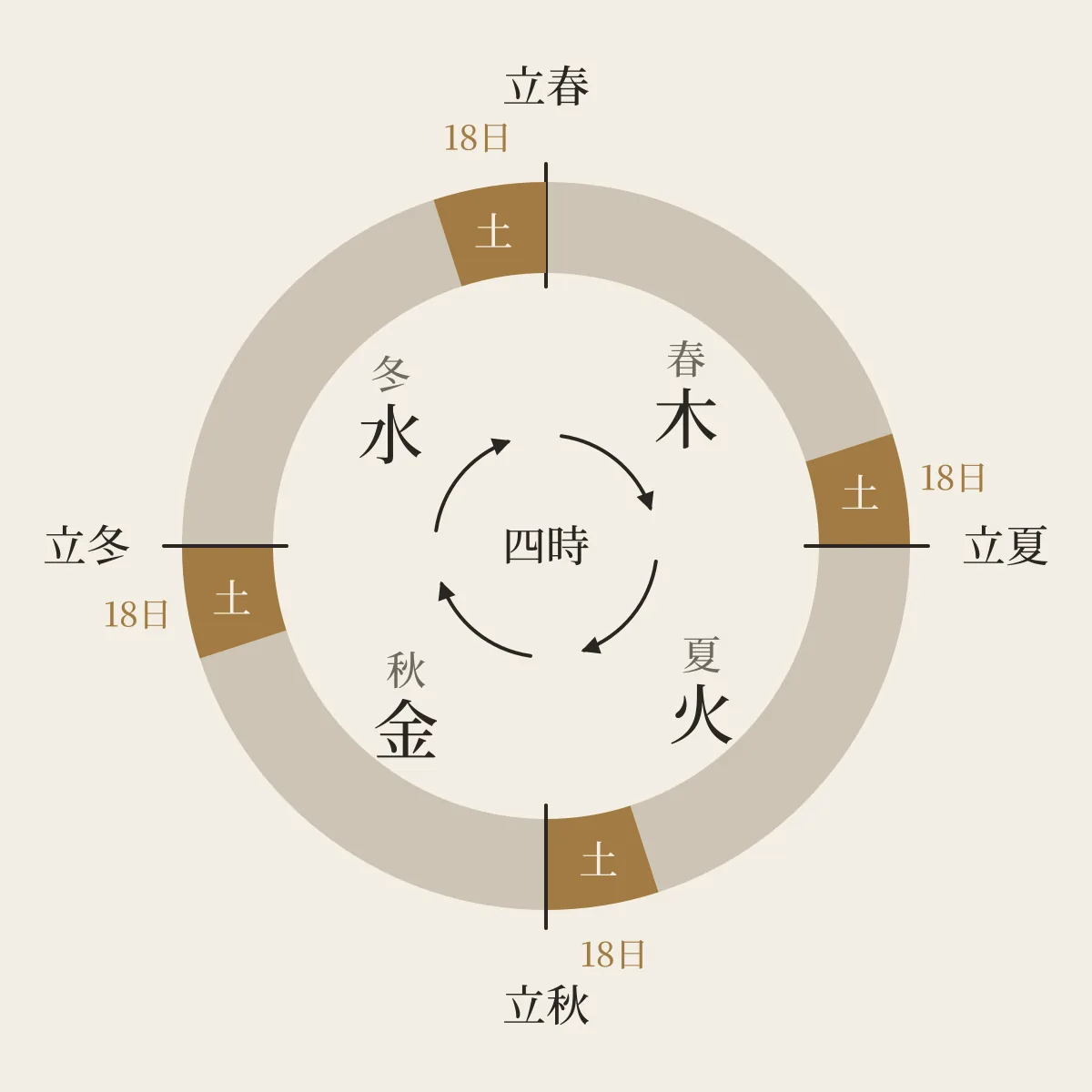
Diagram · Standard Korean Language Dictionary, "towangjijeol"
Stems and branches in the calendar: counting the bok days
Of the places where the Five Elements and the stems and branches have survived in daily life, the closest is probably the summer calendar. According to the Standard Korean Language Dictionary, chobok, the first of the "dog days," falls on the third gyeong day (庚日) after the summer solstice; jungbok on the fourth gyeong day; and malbok on the first gyeong day after Ipchu. A gyeong day is a day whose Heavenly Stem is gyeong (庚). In the table above, gyeong is a Metal stem.
That's also why the bok days fall on different dates every year. A day's stem comes around once every ten days, so when the third gyeong day after the solstice falls changes from year to year. The days when lines form outside samgyetang restaurants are, in effect, set by a Heavenly Stem, so the stems and branches are still at work inside our calendar.
Helping each other, holding each other down
The Five Elements aren't read one at a time; they're read as relations. The encyclopedia's entry on health sums up two relations like this:
| Relation | Order | How to remember it |
|---|---|---|
| Generating (相生): helping | Wood generates Fire → Fire generates Earth → Earth generates Metal → Metal generates Water → Water generates Wood | A common comparison: a cycle where wood feeds fire and fire leaves ash that becomes earth |
| Controlling (相剋): holding down | Wood controls Earth · Earth controls Water · Water controls Fire · Fire controls Metal · Metal controls Wood | Each holds down the one two steps ahead in the generating order |
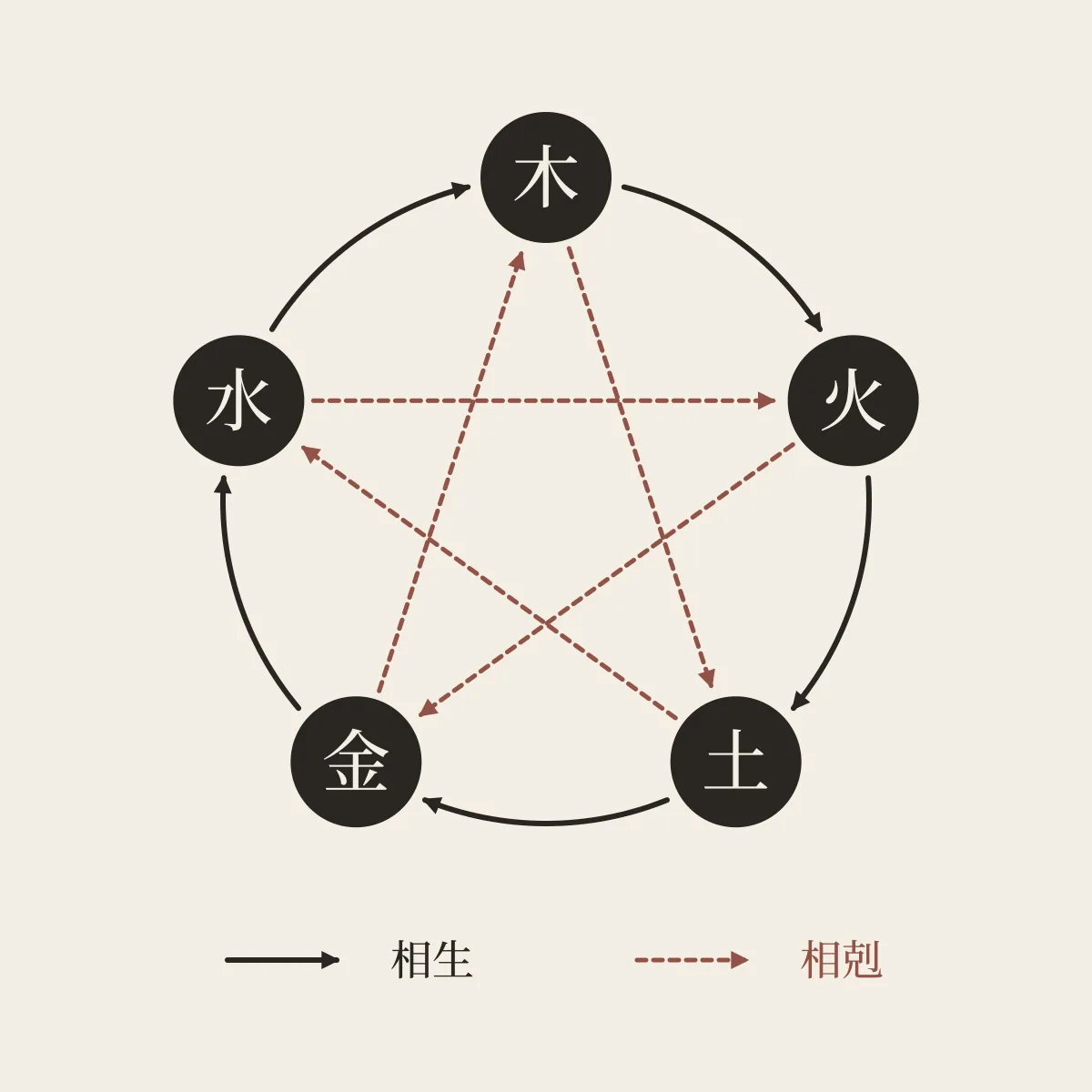
Diagram · Relations based on: Encyclopedia of Korean Culture, "Health"
The basic picture of the Five Elements is that the two relations turn together. It doesn't mean generating is always good and controlling is always bad. Traditional interpretation holds that an overly strong force actually needs something to hold it down for balance to be reached. Like turning down the heat when a pot is about to boil over. Of course, that's a comparison too.
Counting the Five Elements in eight characters
Now let's go back to the opening question. I'll borrow the encyclopedia's illustrative example used in the piece on Saju and the piece on the manseryeok. It is not the chart of any particular person.
Example: Sinhae (辛亥) · Byeongsin (丙申) · Jeongmyo (丁卯) · Giyu (己酉)
| Pillar | Stem | Element | Branch | Element |
|---|---|---|---|---|
| Year | Sin (辛) | Metal | Hae (亥) | Water |
| Month | Byeong (丙) | Fire | Sin (申) | Metal |
| Day | Jeong (丁) | Fire | Myo (卯) | Wood |
| Hour | Gi (己) | Earth | Yu (酉) | Metal |
Count the eight visible characters and you get Wood 1, Fire 2, Earth 1, Metal 3, Water 1. All five categories are present. So is this an "evenly balanced" Saju?
The entry "Saju" calls three or more of an element taegwa (太過, excess) and zero bulgeup (不及, deficiency) when counting the Five Elements. Applying that standard as is, the three Metals in the example above are an excess. Having no empty slot doesn't mean everything is evenly present. That said, the counting standard can differ from app to app and book to book. Here I've used this entry's standard as one example.
Is even good and zero bad?
The entry "Saju" sets two arrangements side by side for comparison.
| Four pillars | The entry's assessment | |
|---|---|---|
| ① The entry's "harmonious Saju" | Gabo (甲午) · Eulhae (乙亥) · Gyeyu (癸酉) · Byeongjin (丙辰) | Yin and yang 2 to 2, evenly present with no excess or deficiency. "A good composition, for a start" |
| ② The entry's "lopsided Saju" | Muin (戊寅) · Sinyu (辛酉) · Gyemyo (癸卯) · Gabin (甲寅) | Too much Wood (Wood excess) and too little Fire (Fire deficiency) |
Counting only the elements in the two arrangements gives this:
| Wood | Fire | Earth | Metal | Water | |
|---|---|---|---|---|---|
| ① | 2 | 2 | 1 | 1 | 2 |
| ② | 4 | 0 | 1 | 2 | 1 |
The entry writes that when yin-yang or the Five Elements are "evenly combined without leaning, it is auspicious," and that when they lean to one side, they should be adjusted toward balance. Going by this entry's explanation, the evenly present one is seen as good for a start, and the one with a 0 is seen as leaning.
The word to notice is "for a start," attached to ①. In another example, the entry explains at length the next step: weighing where the strength of the eight characters is concentrated and which character to read from. Even counts are an assessment at the starting point, not a conclusion.
The commentary on ② doesn't stop at the assessment either. It sees the chart as overflowing with Wood and short on Fire, and explains that meeting Fire fills what is lacking while letting the overflowing Wood energy flow out, and meeting Metal holds Wood down to restore balance. So in this arrangement, Fire and Metal are seen as the yongsin (用神), the forces most important for reaching balance, and the yongsin is said to be given the most weight when reading the Saju. Even for the same arrangement, a method that first weighs the strength of the Day Master (eokbu) might name only Metal, not Fire.
In short, this encyclopedia entry assesses an element with a count of 0 as an imbalance, but doesn't end there; it moves on to a step of finding where to supplement so that balance is reached.
But not all the myeongri classics think alike. The original commentary on the "Treatise on Illness" (疾病論) in Ditian Sui (『적천수』, 滴天髓) says, "What should be whole should be whole, and what should be lacking should be lacking" (全者宜全,缺者宜缺), so it does not see having all five elements as necessary. In Ziping Zhenquan (『자평진전』, 子平真詮) there is a saying that many stems are not as good as heavy roots (干多不如根重). In other words, rather than several stems of the same element floating above, it's stronger for that force to have taken root in the branches below. Reading an empty slot as a defect that must be filled is just one view among several.
What you miss judging by counts alone
Even staying within the frame of traditional interpretation, counting characters is only the first step. Besides counts, the commentary in the entry "Saju" brings up things like these:
| What counting misses | Plain explanation |
|---|---|
| Strength | Even a single character is seen to have different strength depending on whether it suits the birth month (the Month Pillar) and whether it has roots in other characters |
| Hidden characters | There are amjanggan (暗藏干), commonly called jijanggan (支藏干): other stems believed to be hidden inside a branch. Even if an element shows 0 on the surface, it is sometimes read as present inside |
| Relation to the Day Master | The same element means different things depending on whether it helps or holds down the Day Master |
| Flow of time | Other elements are believed to come in through daeun, in 10-year units, and se-un, in 1-year units |
Another example in the entry shows in a table that the branch in (寅) contains gap, byeong and mu. Apply that directly to arrangement ②: there are two in, so even though Fire is 0 on the surface, the chart holds byeong (丙, Fire) inside in. The eight visible characters and the characters actually used in interpretation can differ. Read that way, a 0 on a results screen doesn't necessarily mean "none at all."
Add one more thing: as we saw with arrangement ② above, which force is taken as the yongsin can also differ by interpreter and school.
Phrases you often hear, read a different way
| A phrase you often hear | A more accurate way to put it |
|---|---|
| "No Fire, so this person has no passion" | Element counts are not a personality diagnosis. Even traditional interpretation judges from the whole structure |
| "You need all five elements for a good Saju" | The encyclopedia entry, too, sees an even composition as good "for a start." But even with all five present, one side can still be heavy, and among the classics there is also the view that having all five isn't necessary |
| "Wear clothes in the color of your missing element and your luck will change" | Whether it's clothing color, names or directions, gaeunbeop, practices claiming to adjust fortune through something, are customs within the tradition. They are not methods with verified effects |
| "Lots of Wood, so your liver is weak" | Explanations that link the Five Elements to the body are part of traditional medical theory. Check physical symptoms with a medical professional |
| "Born in summer, so lots of Fire" | The birth month is reflected in the Month Pillar, but the season doesn't decide the element counts. The counts come from counting the eight characters. That said, myeongri separately weighs the strength of each force, and how cold or hot a Saju is (johu), by the season of birth |
Seen from outside the tradition
So far, we've followed how myeongri explains itself. This blog does not treat the Five Elements as a verified method for predicting personality, health or the future. The theory of yin-yang and the Five Elements is an important framework for understanding East Asian thought and ritual, calendars and everyday culture. The way bok days are counted and words like towangjijeol are traces of that. But recognizing its value and using it as grounds for judging facts are different matters.
When you look at your element counts, I hope you'll remember just this much:
- Read an empty slot not as a flaw in the person but as a question to start interpretation from.
- Even if an interpretation sees a lopsided composition as less auspicious, don't turn that assessment into a label for the whole person, like "a deficient Saju" or "a bad palja." This isn't the tradition's conclusion; it's a principle this blog keeps.
- Make decisions with big consequences, such as health, money or legal matters, on the evidence of the relevant field, not the Five Elements.
Sources
- Academy of Korean Studies, Encyclopedia of Korean Culture (한국민족문화대백과사전): Theory of yin-yang and the Five Elements, Saju, Health
- Ditian Sui, "Treatise on Illness," original text and commentary: Chinese Wikisource, "滴天髓"
- Ziping Zhenquan, "論十干得時不旺失時不弱": Dongli Shuzhai edition
- National Institute of Korean Language, Standard Korean Language Dictionary: towangjijeol, towangyongsa, chobok, jungbok, malbok, gyeongil
- Korean Wikipedia, Jiji (calendar) — used to check the element of each Earthly Branch