
What Does Mansin Mean? Stories from Dictionaries and Old Records
Korean dictionaries define mansin as a respectful term for a female mudang, or shaman. The same name survives in a song sung in gut rituals, in shaman paintings held by a museum, and in the writing of a researcher who has met today's mudang. We also look at whether the characters 萬神 and the reading 'serving ten thousand gods' are really where the word comes from.

National Folk Museum of Korea Archive · "Day 2 Main Gut – Personal Blessing" (2017-082-00001216) · Photo by Hong Seunghun · KOGL Type 1
On this page
The youngest princess has brought her sick parents back to life with healing water, and the king asks what she wishes for. She answers that she will become the "Inwiwang of the mansin." This is a passage from "Princess Bari," a song sung in gut rituals. In the scene where an abandoned daughter becomes the ancestor of the mudang, Korea's shamans, the word mansin appears.
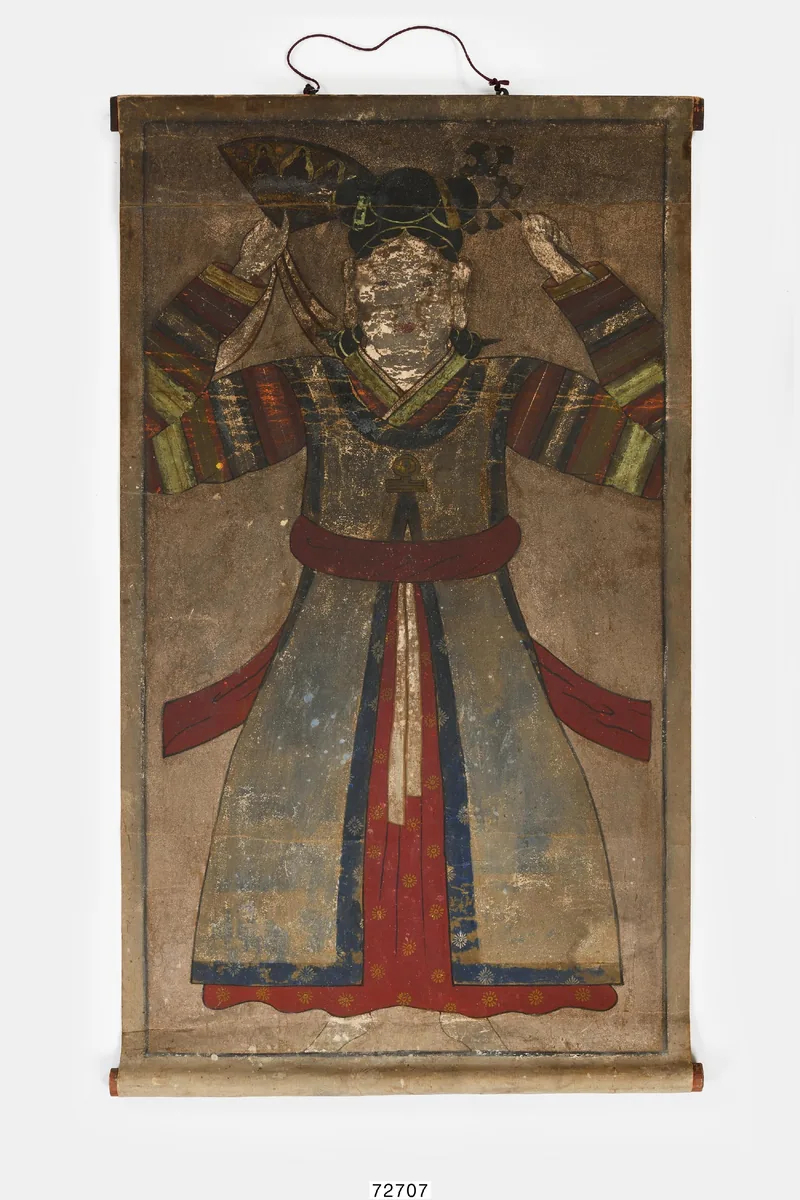
The same word is attached to the name of a worn shaman painting in a museum, and it is also used for today's mudang who fold up their spirit paintings and carry them to a ritual. The dictionary entry is short, but if you follow whom this word has named, and how, the story gets fairly long.
Mansin in the dictionary
The National Institute of Korean Language's Standard Korean Language Dictionary lists mansin as a noun in the field of folklore and defines it as "a respectful term for a munyeo (巫女)," that is, a female mudang. It adds that the word "is sometimes written as 萬神, borrowing Chinese characters." So it is not simply a word for a female mudang but an honorific one, and 萬神 is a set of characters borrowed to match the sound. The dictionary does not present these characters as the root of the word. A different word with the same sound, mansin (滿身), means "the whole body."
The dictionary says nothing about when or where the word came into being. Urimalsaem, the institute's open dictionary, gives the same definition and also lists Manshin, director Park Chan-kyong's film released in 2014, but it does not discuss the origin either. Since even a film title is recorded there, it is at least clear that the name is still in use.
The "ten thousand gods" reading
Read character by character, 萬神 means "ten thousand (萬) gods." That is why the explanation "a person who serves all the gods" so often follows it. The Global World Encyclopedia (『글로벌 세계 대백과사전』), transcribed on Wikisource, does the same in its entry on musin (巫信): listing the many names for a mudang, it gives as an example that a mudang who serves every god without exception (無神不祀) is called mansin. But this entry only says that such names were attached in old records according to what a mudang did, without saying which records. It explains the name in light of the work, not how the word actually came about.
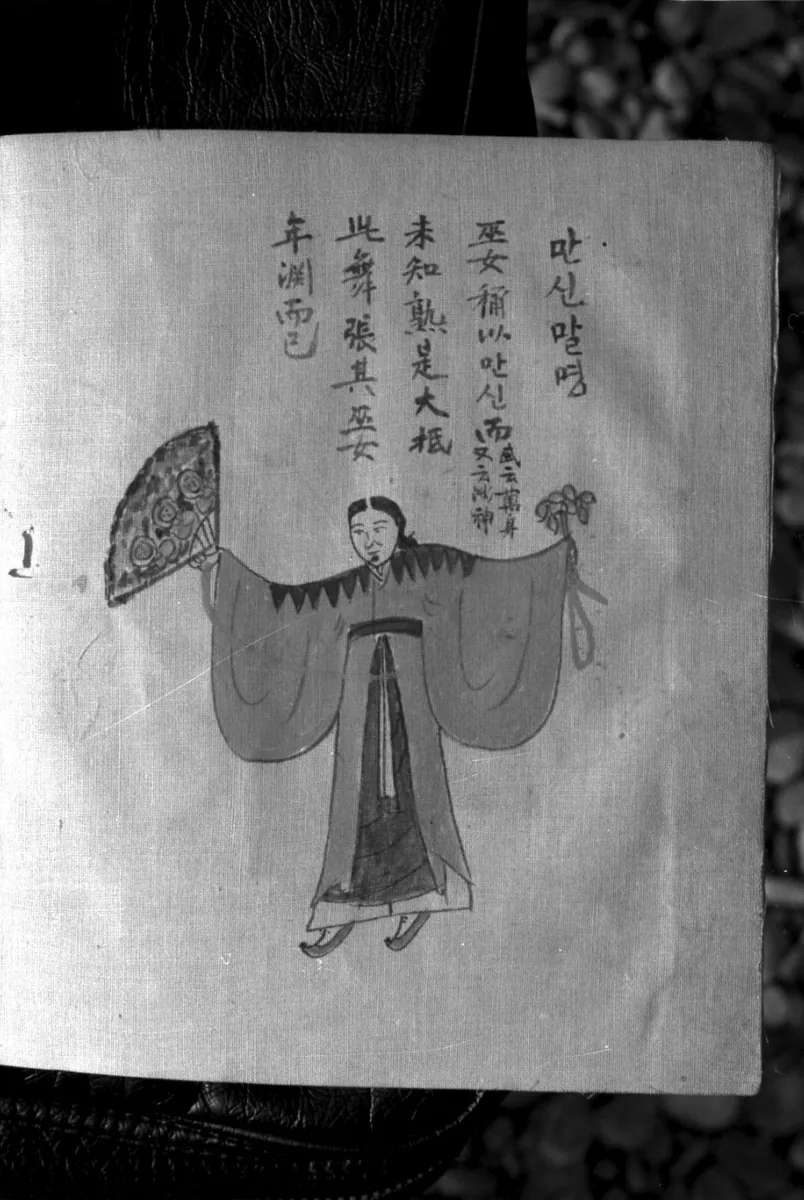
Something similar is true of Malmyeong, a spirit served in the gut of Seoul and central Korea. The Encyclopedia of Korean Culture (『한국민족문화대백과사전』), published by the Academy of Korean Studies, opens its entry on Malmyeong by noting that "its etymology and origin have not yet been clarified." Only after that come an old record that Manmyeong (萬明), the mother of Kim Yu-sin, became a spirit, and Yi Neung-hwa's view that Manmyeong was therefore called Malmyeong. Explanations that link a word to plausible Chinese characters or a historical figure are fun. Still, the encyclopedia wrote "not yet clarified" first. It is worth reading the "ten thousand gods" explanation in the same order.
National Folk Museum of Korea Archive · "Mudang naeryeok, Mansin Malmyeong" (1966-001-00000355) · Photo by Jang Ju-geun · KOGL Type 1
Where mansin turns up
Gathering the places where mansin appears in dictionaries and other sources gives this:
| Where | How it is used | What kind of text |
|---|---|---|
| Standard Korean Language Dictionary | A respectful term for a female mudang | Dictionary definition |
| Urimalsaem | Same meaning, plus a 2014 film title | Definition and modern usage |
| Encyclopedia entry "Mujosin" | "Mansin Halmeoni" among the ancestral gods of mudang; the author explains the word as "an honorific for a mudang" | The encyclopedia author's explanation |
| Encyclopedia entry "Malmyeong" | The spirit name "Mansin Momju Daesin Malmyeong" | A list of spirit names invoked in gut |
| Princess Bari plot in "Mujosin" | When the revived king asks her wish, Princess Bari says she will become the "Inwiwang of the mansin," that is, a mudang | Summary of a shaman song's plot |
| Writing by anthropologist Laurel Kendall | Consistently calls mudang of the Seoul and Hwanghae traditions mansin, and also writes of male mudang as pasku mansin | A researcher's term from the field |
| Global World Encyclopedia | Example: a mudang who serves every god is called mansin | An interpretation of the name |
In the field, the word is used for male mudang as well. The dictionary calls it an honorific for a female mudang, but in her essay for the 13th Gwangju Biennale, Kendall writes that "most (but not all) mansin are female," and she calls male mudang pasku mansin. The Korean translation renders the passage as "대부분(다 그렇진 않지만)의 만신은 여성" ("most mansin, though not all, are women"). In the field, then, mansin is a little wider than the dictionary definition.
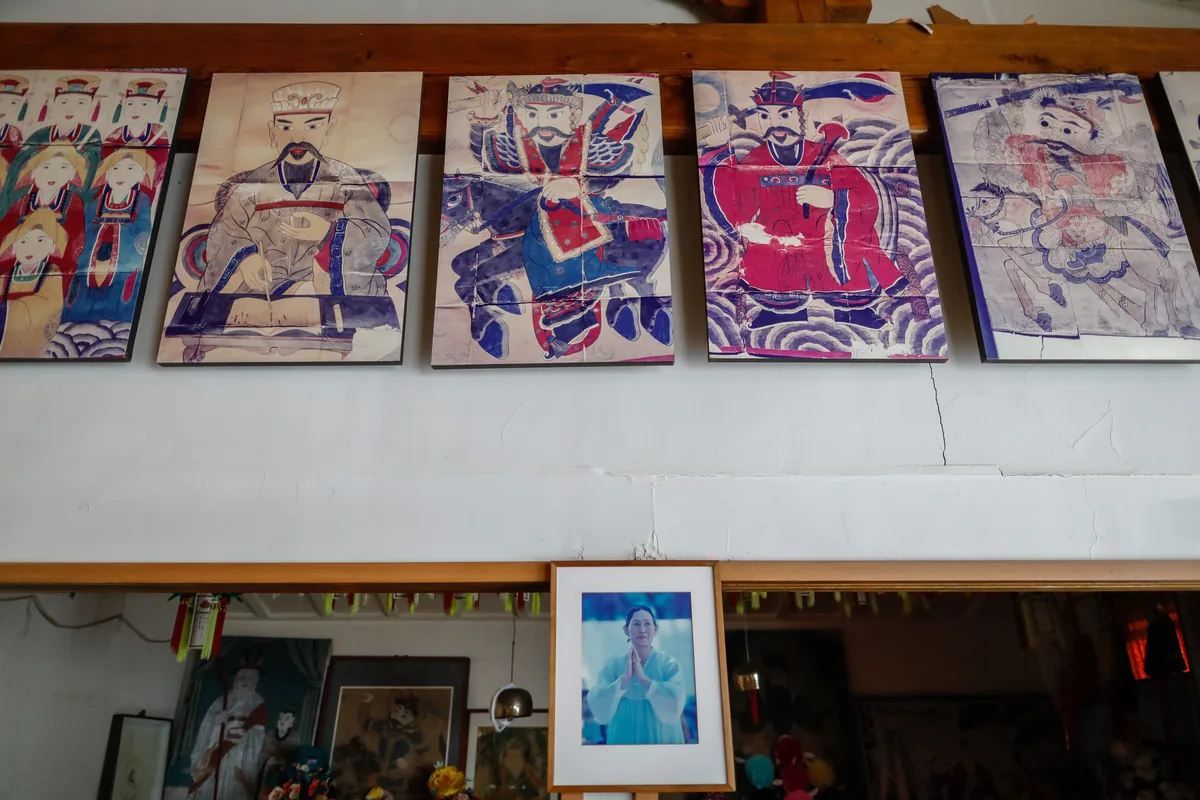
National Folk Museum of Korea · "Mansindo (萬神圖)" (Folk 72707) · Artist unknown · Original · KOGL Type 1 · Resized only
The many names for a mudang
Mansin is one of the names for a mudang. The Encyclopedia of Korean Culture defines mudang as "a religious specialist who serves the gods and conducts gut rituals," and notes that they are also called muin, mu, mugyeok, munyeo, dangol and simbang. Male mudang, it says, were also called gyeok, baksu, hwaraengi and yangjung.
The same entry divides mudang into two types. The paths into the role and the regions in the table below also follow that entry. It is a scholarly classification written in 1995, so it does not show today's distribution as it is.
| Type | How one becomes a mudang | Region mainly described | Names used with it |
|---|---|---|---|
| Gangsinmu (降神巫) | An experience understood as a god descending, and an initiation gut | Central and northern | mudang, baksu |
| Seseummu (世襲巫) | Inheriting the right to perform gut through the family | Southern | dangol in Honam, mudang in Yeongnam, simbang in Jeju |
Korean shamanism and Saju are different traditions
When people talk about mansin, Saju often comes to mind too. But the two have different roots.
| Korean shamanism (musok) | Saju and myeongri | |
|---|---|---|
| Center | Mudang who serve the spirits, and gut | Eight characters written from the year, month, day and hour of birth |
| Method | Gut, gongsu (words believed to carry a god's speech), divination | Interpreting the relations of yin-yang, the Five Elements and the stems and branches |
The encyclopedia defines musok as "a religious phenomenon transmitted with the mudang at its center" (musok), and Saju as the year, month, day and hour of birth, worked out in order to divine fortune and misfortune (Saju).
One person may practice both, but the gut of a shrine and the calculations of a manseryeok calendar are separate systems.
A record without the word mansin: "Nomupyeon"
Old records about Korean shamanism are rare. That is one reason "Nomupyeon (老巫篇)," a poem about an old mudang by Yi Gyu-bo, a scholar-official of the late Goryeo period, is quoted so often. The encyclopedia's entry on "Nomupyeon" says the poem appears in his collected works, Donggukisanggukjip, and calls it a valuable source given that hardly any old records on shamanism survive.
Read the translation in the Korean Classics Database yourself and the preface lays out why the poem was written. An old mudang lived next door to the east, and he disliked hearing the crowds that gathered there every day. He had no grounds to drive her out, until the state ordered mudang to be moved far from the capital. The poet says he was so pleased that he wrote the poem to celebrate.
Yet the eye of the man who resented her is quite detailed. In the translation, the poet draws the mudang with a wrinkled face, "fifty years old." For a poem titled "old mudang," that is an unexpected age. He also records the people crowding her gate, the speech she spun out thin like birdsong, and how she leapt so high her head touched the beam. He notes that she built a shrine niche a little over five ja (an old unit of length) from bound wood and called it Jeseok, and that she painted the gods in red and blue on every wall. By the time you reach the lines saying he took up a sharp knife and almost went over several times, stopping only because there was a law, the poet seems to have no intention of hiding his feelings.
The same entry summarizes the poem as distinguishing female mudang from baksu, and as depicting divination when a god descends, a shrine hung with Jeseok, Chilseong and shaman paintings, and a vigorously leaping dance. It concludes that one can infer that the functions of the mudang and the form of gut, similar to the shamanism of today's central region, were already established in the Goryeo period. In a way, it is thanks to a man who wanted mudang gone that this mudang's likeness has survived to this day.
And the word mansin never appears in the translation of this poem. The translation calls them mudang and baksu instead. A record about mudang being old does not mean the word mansin is equally old.
Mansin in a shaman song: how an abandoned princess became the ancestor of mudang
Let's go back to the opening scene. The encyclopedia introduces the song "Princess Bari" as a long narrative shaman song sung in rituals that send the souls of the dead to the other world. It is sung in Seoul's jinogi-gut, Honam's ssitgim-gut and the East Coast ogu-gut, and more than a hundred versions have been recorded across the country.
The common plot as the encyclopedia sums it up goes like this:
- A king and queen have six daughters, and their seventh child is a daughter too.
- The seventh princess is abandoned.
- Years pass, the parents fall ill, and they learn that only a healing water can save them.
- The six older sisters each make excuses and refuse.
- Princess Bari, who was abandoned, sets out on a long journey, obtains the healing water and pays a price for it.
- Princess Bari revives her parents, and her deed is recognized.
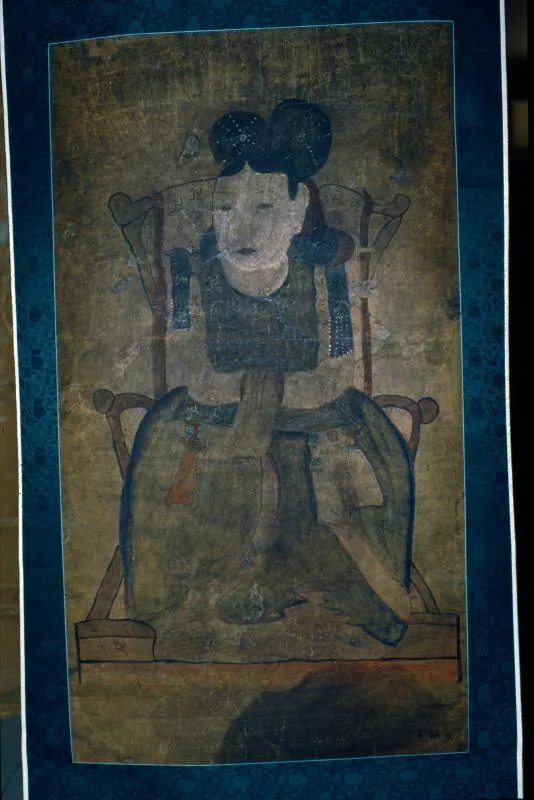
The scene at the start of this piece comes at the end of that plot. In the plot given in the same encyclopedia's entry on Mujosin, the ancestral gods of mudang, Princess Bari says she will become the "Inwiwang of the mansin," that is, a mudang, and so becomes the ancestral god of mudang. The abandoned youngest daughter becomes the guide who leads the dead to the other world, and mudang serve her as their own ancestor.
National Folk Museum of Korea Archive · "Seoul Shaman Painting – Princess Bari" (2012-041-00008107) · Collected by Kim Taegon, donated by Son Jangyeon · KOGL Type 1
The content differs from version to version. According to the Princess Bari entry above, in versions from what is now North Korea, Princess Bari sometimes dies after bringing back the healing water. Because the ending changes, it is more accurate to read the story not as "there really was a princess who became a mudang" but as "this is how mudang have sung their own origin."
There is also an account that this song does not appear in the gut of the islands or of Hwanghae Province. Among the people Kendall calls mansin are mudang of the Hwanghae tradition. If Princess Bari is not sung in their gut, then the name mansin and the Princess Bari story do not always go together.
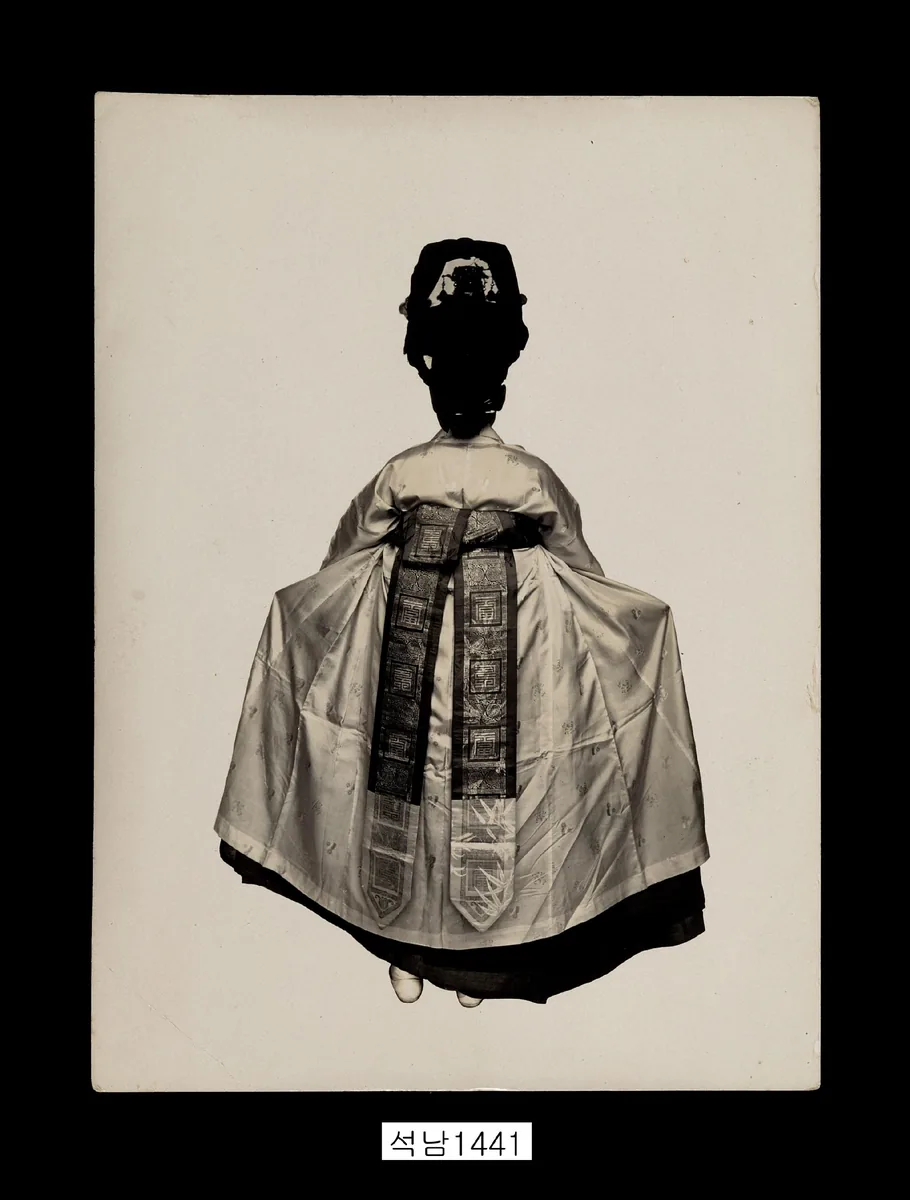
National Folk Museum of Korea · "Female Shaman (巫女) in the Ritual Costume (神裝) of Princess Bari" (Seoknam 1441) · Photo by Akiba Takashi and Akamatsu Chijō, collected by Song Seok-ha · Original · KOGL Type 1 · Resized only
There are records of the state mobilizing mudang, too
Under King Sejong of Joseon, the state sometimes used mudang to care for the sick. The author of the encyclopedia's mudang entry we saw earlier explains that when fever spread, the king mobilized mugyeok to treat the sick, and reduced the shaman tax (巫稅) and exempted from corvée labor those who worked hard. Mudang were also attached to the East and West Hwarinwon (東西活人院), the institutions caring for the sick of the capital, under direct government command.
People believed mudang had the power to heal, and the state brought that belief into its institutions. In late Goryeo there was an order to move mudang far from the capital; under Sejong of Joseon, the state mobilized mudang to care for the sick. Setting just a few records side by side is enough to see that the state's attitude toward mudang did not run in one direction.
Two texts that describe the same people differently
Even about the same people, the sentences change depending on who is writing. The encyclopedia's mudang entry, written in 1995, explains that the mudang enters a state of ecstasy through dance, makes contact with the gods and acts as a spirit medium (靈媒者) who conveys people's wishes to them.
Kendall's essay points in a slightly different direction. She writes that the mansin is not a spirit medium, and not "just" a performer either. Mansin say that they are sometimes taken over so powerfully that they move and speak beyond their own will, she notes, but to perform gut day after day requires a skilled sense of how to carry a gut through. In a footnote, she states separately that she would not describe mansin performing gut as being "in trance."
There is no need to decide which is right. Someone who has to write a dictionary-style definition and a researcher who has watched from close by for a long time chose different words for the same people.
Mansin today: people who fold up their paintings and go
In modern times, gut is sometimes protected as intangible heritage. According to the encyclopedia's entry on Seohaean Baeyeonsin-gut and Daedong-gut, this gut was designated an Important Intangible Cultural Property in 1985, and the female mudang Kim Geum-hwa was named as holder of the skill. Two rites are handed down together: the baeyeonsin-gut, held aboard a boat to pray for safety at sea and a good catch, and the daedong-gut, which prays for the well-being of the village.
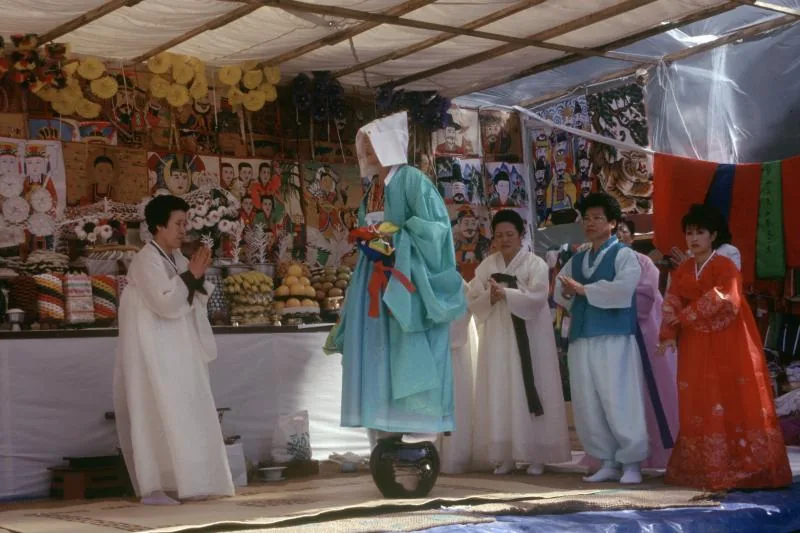
National Folk Museum of Korea Archive · "Kim Geum-hwa Mangu Daetak-gut, Yonggungtagi (Kim Geum-hwa)" (1997-010-00000518) · Photo by the National Folk Museum of Korea (Yang Jongsung) · KOGL Type 1
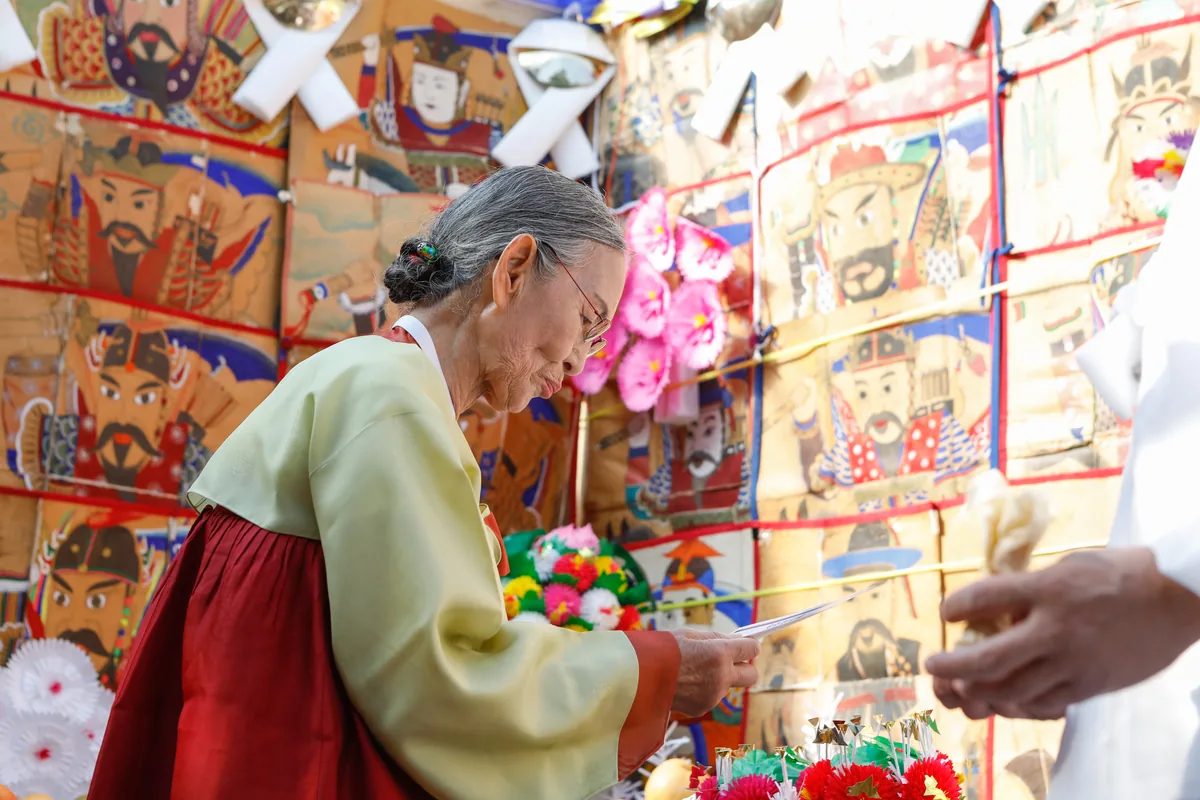
Kendall's essay contains one small scene. Mansin of the Hwanghae tradition fold up the spirit paintings hanging in their shrines and carry them to the ritual, so the paintings they used bear characteristic creases. It is a trace that the paintings lived not on a gallery wall but in a working person's bags.
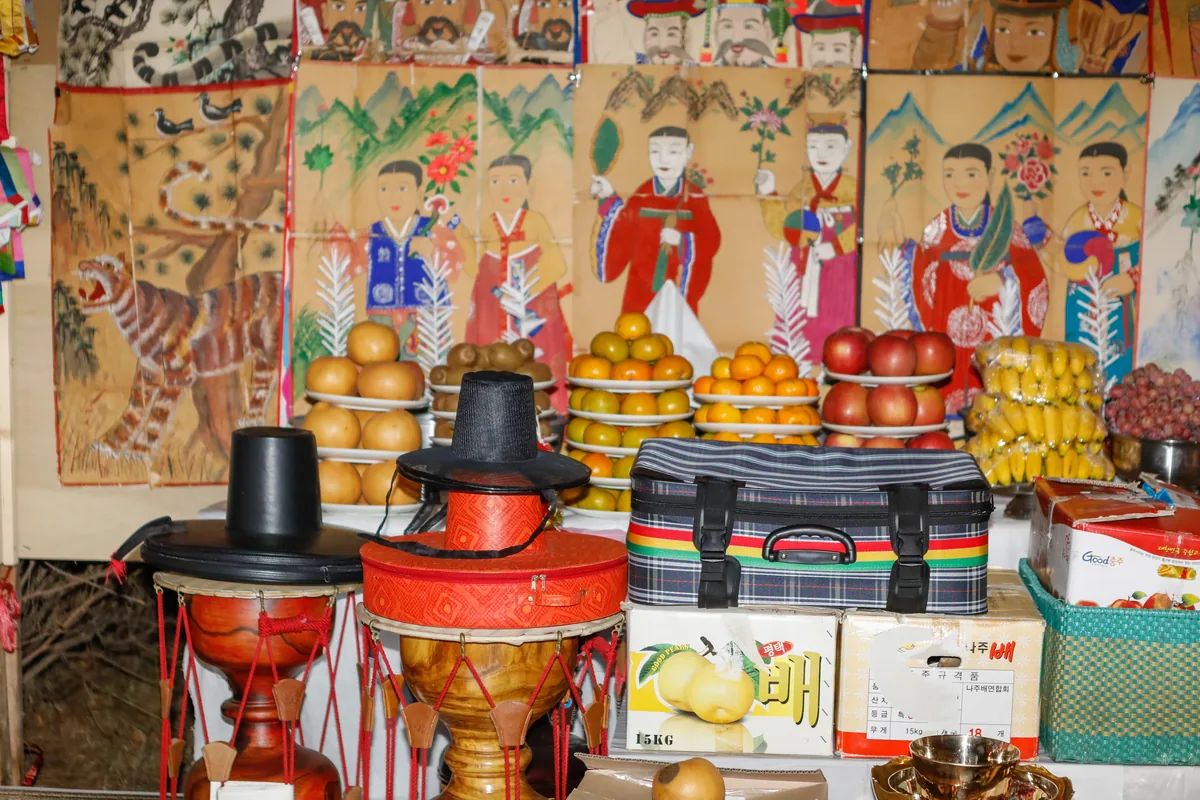
National Folk Museum of Korea Archive · "Main Gut Day 1 – The Ritual Space" (2017-082-00000237) · Photo by Hong Seunghun · KOGL Type 1
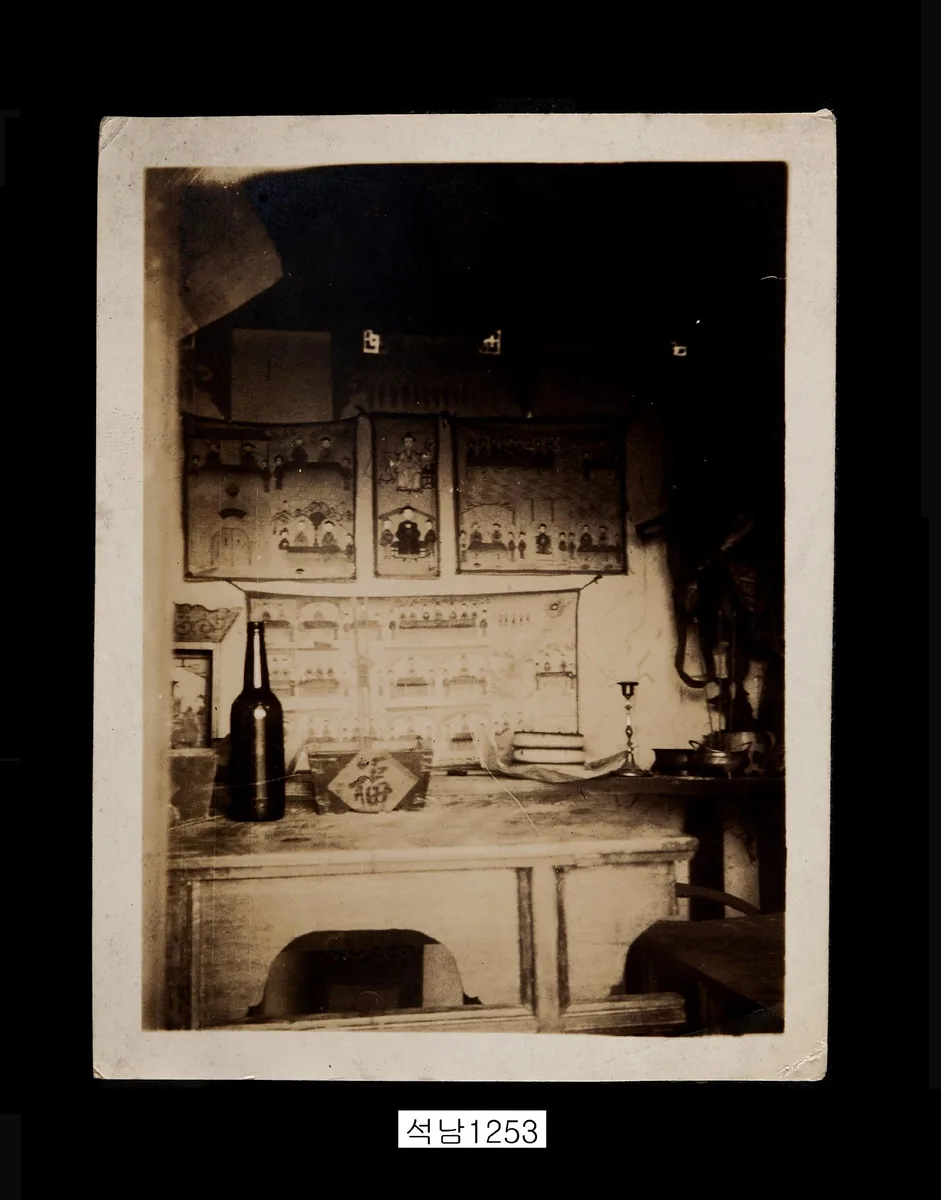
National Folk Museum of Korea · "Gutdang" (Seoknam 1253) · Photo by Akiba Takashi and Akamatsu Chijō, collected by Song Seok-ha · Original · KOGL Type 1 · Resized only
The same essay explains the mansin's gut as an occasion that calls up family members who have passed away, revives memories of them and eases grief. It also writes that the form of the gut that consoles the souls of the dead became a vehicle for political theater after the democracy movement of the 1980s, a stage for calling up the victims of modern Korean history. The gut Kendall portrays is a place where those left behind call back the ones who have gone.
National Folk Museum of Korea Archive · "Shrine Inside Geumhwadang – Maji" (2017-082-00000014) · Photo by Hong Seunghun · KOGL Type 1
The word mansin, once more
In the dictionary, mansin is a respectful term for a female mudang. In the shaman song "Princess Bari," it appears where the princess tells the king she will become the "Inwiwang of the mansin," that is, a mudang. With that answer, the princess becomes the ancestral god of mudang. In the museum, it is attached to the name of a shaman painting with flaking paint; in Kendall's writing, it names mudang of the Seoul and Hwanghae traditions and is used for male mudang too. The explanation "one who serves ten thousand gods" follows this word more often than any other, but the dictionaries and encyclopedias read in this piece do not offer it as the word's origin.
Sources
- National Institute of Korean Language, Standard Korean Language Dictionary, "만신"
- National Institute of Korean Language, Urimalsaem, "만신"
- Academy of Korean Studies, Encyclopedia of Korean Culture (한국민족문화대백과사전): Mudang, Musok, Mujosin, Malmyeong, Nomupyeon, Princess Bari, Seohaean Baeyeonsin-gut and Daedong-gut, Saju
- Institute for the Translation of Korean Classics (한국고전번역원), Korean Classics Database (한국고전종합DB), Donggukisanggukjip, Collected Works vol. 2, "Nomupyeon with Preface," Korean translation
- Wikisource, Global World Encyclopedia, "Musin"
- Laurel Kendall, 13th Gwangju Biennale, "God Pictures and Korean Shamans," English original, Korean translation