
The Month of Welcoming and Sending Off the Wind Goddess: Jeju Chilmeoridang Yeongdeunggut
On Jeju, people have long held that Yeongdeung Halmang, goddess of the wind, crosses the sea in the second lunar month and then leaves again. We look at when and in what order the Chilmeoridang Yeongdeunggut that welcomes and sends her off is held, and how haenyeo divers and boat-owning families have put on this ritual together.
On this page
On Jeju Island, the second lunar month has long been called Yeongdeungdal, "the Yeongdeung month." It's the month when Yeongdeung Halmang, a goddess said to govern the wind, comes across the sea to visit and then leaves. Among the rituals that welcome and send off this goddess, the Chilmeoridang Yeongdeunggut of Geonip-dong in Jeju City was designated a national intangible heritage in 1980, and in 2009 it was inscribed on the UNESCO Representative List of the Intangible Cultural Heritage of Humanity. I followed the records to see when this ritual is held, by whose hands, and what it prays for.
At a glance
| Item | Details | Source |
|---|---|---|
| Name | Jeju Chilmeoridang Yeongdeunggut | Korea Heritage Service |
| Place | The Chilmeoridang shrine in Geonip-dong, Jeju City; now moved to the foot of Sarabong | Encyclopedia of Korean Culture |
| Time | Welcoming rite on the 1st day of the 2nd lunar month, farewell rite on the 14th | Encyclopedia of Korean Culture; UNESCO (2nd lunar month, farewell rite two weeks after the welcome) |
| Deities served | The Yeongdeung deity (Yeongdeung Halmang), the Dragon King, the village's bonhyangdang deities and others | UNESCO; Encyclopedia of Korean Culture |
| Who prepares it together | Simbang (Jeju's mudang, or shamans), haenyeo divers, and villagers centered on boat-owner and fishing families | UNESCO; Encyclopedia of Korean Culture |
| National designation | National Intangible Heritage, designated November 17, 1980; custodian organization: the Jeju Chilmeoridang Yeongdeunggut Preservation Society | Korea Heritage Service |
| UNESCO | Inscribed on the Representative List of the Intangible Cultural Heritage of Humanity in 2009 (4th session of the Intergovernmental Committee) | UNESCO |
Not Lunar New Year, not Ipchun: a ritual of the second lunar month
Some people take the Yeongdeunggut for a New Year ritual, but the timing is different. Seollal, the Lunar New Year, falls on the 1st day of the 1st lunar month and Daeboreum on the 15th; the Yeongdeunggut is held in the following month, the 2nd lunar month. Its reference point also differs from solar terms like Ipchun, which are set by the movement of the sun.
Converting to the solar calendar makes it easier to picture. Checking with the Korea Astronomy and Space Science Institute's lunar-solar converter, the 1st day of the 2nd lunar month in 2026 is March 19 and the 14th is April 1. In 2027, the 1st day of the 2nd lunar month is March 8 and the 14th is March 21. The same lunar date moves back and forth by more than ten days in the solar calendar from year to year. For the actual schedule of events, it's best to check that year's calendar and the notices of the organization that carries on the ritual.
UNESCO's inscription description reads the goddess's departure as a sign of spring's arrival. She comes at the tail end of winter, while the sea is still rough, sows seeds and calms the waves, and then leaves. So rather than a ritual that opens the new year, it's closer to the records to see it as a ritual at the threshold where work at sea begins again.
The shrine of a seaside village
Chilmeori is an old name for Geonip-dong. According to the Encyclopedia of Korean Culture entry "Jeju Chilmeoridang Yeongdeunggut", Geonip-dong was originally a small fishing village outside the walls of Jeju town, and its people lived by fishing and haenyeo diving. Perhaps that's why the village's bonhyangdang deities, its guardian gods, also look after work at sea. The husband god, Dowonsugamchaljibanggwan, watches over the village land and the lives and deaths of its people, and the wife goddess, Yowanghaesinbuin, is said to protect the work of fishermen and haenyeo, as well as people who are away from the village.
Yet the great ritual of this shrine devotes more care to a guest goddess from across the sea than to the village's own guardians. The same entry finds the reason in Geonip-dong having been purely a fishing village. Even the rituals are called the Yeongdeung welcoming rite and the Yeongdeung farewell rite, not the bonhyangdang ritual.
The entry "Geonip-dong Chilmeoridang" describes the shrine as a spot on a seaside hill east of Jeju Port, enclosed by a square stone wall, with an altar built in front of an inner wall carved with spirit tablets. The deities of Namdang, a separate shrine that had stood inside the village, Namdang Harubang and Namdang Halmang, were also enshrined here, it says. According to the Yeongdeunggut entry, the shrine originally stood at a place called Chilmeori and was moved to the foot of Sarabong as the city grew. Though it has moved, the shrine is still called by the old place name, Chilmeori.
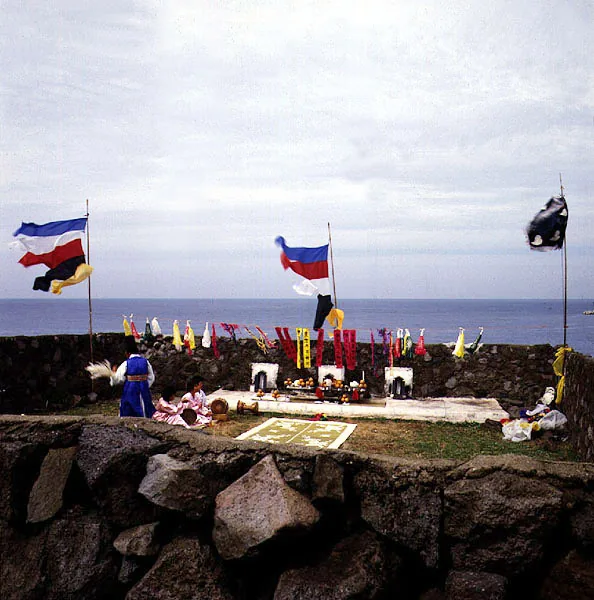
Korea Heritage Service · "Jeju Chilmeoridang" · Original · KOGL Type 1 · Unaltered
When does Yeongdeung Halmang leave?
Where does Yeongdeung Halmang come from? Some records say an island of one-eyed people; others say Gangnam Cheonjaguk, a kingdom south of the river. The day she arrives is generally the same, the first day of the second lunar month, but the day she leaves varies a little from story to story.
- The Chilmeoridang Yeongdeunggut entry: she returns to her homeland on the 15th of the 2nd month.
- UNESCO's description: she leaves on the fifteenth day, and this announces the arrival of spring.
- The entry "Yeongdeung Halmeoni": she returns on the 25th of the 2nd month.
- The Urimalsaem definition cited by the same encyclopedia: a grandmother who comes down from the sky on Yeongdeung day, goes from house to house, and goes back up on the 20th of the 2nd month.
The dates differ by source, and none of the sources says which village's tradition each date comes from. Even within the Chilmeoridang Yeongdeunggut entry, the date of the farewell rite (the 14th of the 2nd month) and the date the goddess is said to leave (the 15th) are written side by side, one day apart. In effect, the ritual sees her off the day before she goes.
The Yeongdeung Halmeoni entry also preserves several stories from daily life. Halmang goes around the shore eating bomal (a kind of sea snail), so in the 2nd month the bomal shells are empty; if it's cold in the 2nd month, people said Yeongdeung Halmang had come in fine clothes, and if it rained, that she had come wearing her ujang (rain cape). Taboos have also come down: while she stays, people don't go out by boat and don't do laundry. These are sayings that turn a month of rough weather into the time a goddess is staying.
There are similar deities on the mainland too. The same entry explains that wind deities of the 2nd month, with names as varied as Yeongdong Halmanne, Yeongdong Halmasi and Pungsin Halmanne, are spread across many parts of South Korea. Stories sometimes attach to them: if she brings her daughter, the wind blows; if she brings her daughter-in-law, it rains. But while the mainland Yeongdong deity is mostly served by each household on its own, Jeju's Yeongdeung Halmang is said to differ in being served as a village deity who protects fishing. Even a similar wind deity becomes, in a seaside village, a guest of the whole village rather than of one household.
From welcome to farewell
The encyclopedia entry lists the order of the Chilmeoridang ritual as chogamje, bonhyangdeum, yowangmaji, maeuldoaengmageum, ssideurim, ssijeom, baebangsong and dojin. Put briefly, here's what happens in each:
- Chogamje: Announce when, where, by whom and why the ritual is held, and invite all the gods to be seated.
- Bonhyangdeum: Invite the husband and wife deities of Chilmeoridang, and entertain them with dance while singing "Seoujetsori."
- Yowangmaji: Plant green bamboo branches about 1 m tall in the ritual space, in two rows of eight, as the road the gods will travel; show in song and dance how that road is cleared and swept; then pray for good work for fishermen and haenyeo.
- Maeuldoaengmageum: Pray for the villagers' safety, grounded in the bonpuri (a sung story of a deity's origins).
- Ssideurim: Scatter millet seed into the sea, calling it the seed of what haenyeo harvest, such as seaweed and abalone.
- Ssijeom: Back in the ritual space, scatter millet seed again on a straw mat, and divine the year's "sea harvest" from how densely it spreads.
- Baebangsong: Load a little of each offering onto a small boat made of straw, carry it out to sea on a fishing boat, and set it afloat toward the east.
- Dojin: Send all the invited gods back.
UNESCO's description presents the same ritual as two occasions, a welcome and a farewell. In the welcoming rite, the gods are called, a good catch is prayed for, and a three-part play is performed to delight the ancestral gods; two weeks later, in the farewell rite, liquor and rice cakes are offered, the Dragon King is welcomed, divination is done with millet seed, and older men of the village set a straw boat afloat on the sea. What appears in both records is the millet seed and the straw boat. The seeds are scattered on the sea, and the boat leaves carrying the goddess.
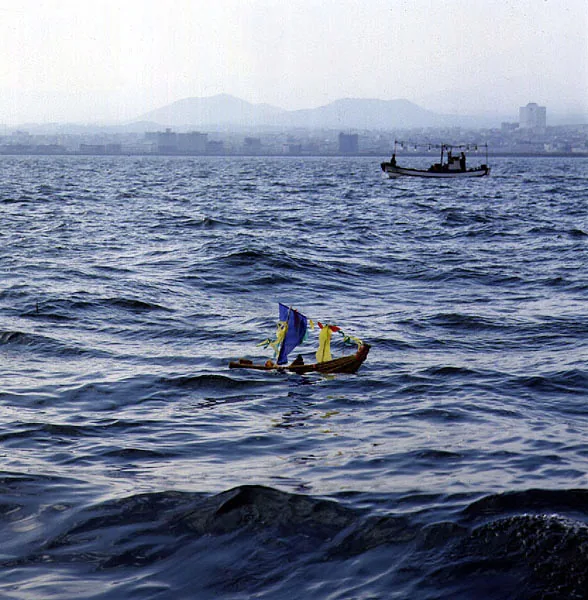
Korea Heritage Service · "The Straw Boat Sent Off" · Original · KOGL Type 1 · Unaltered
Who has kept this ritual going?
The person who leads the ritual is the simbang, the name for a mudang in Jeju. The names used for mudang in different regions are laid out in the piece on the meaning of mansin. But it isn't only the simbang who fill the ritual ground. UNESCO's description notes that haenyeo and boat owners have supported the ritual by preparing food and presenting offerings, and the encyclopedia entry explains that on the morning of the ritual, the head of the boat owners' association and the head of the neighborhood carry the prepared offerings to the shrine, while each household separately prepares offerings for its own blessings and gathers. It is a ritual for the whole village, and at the same time a place where each household's prayers rise too.
Simbang An Sa-in, who was in charge of the shaman songs, was recognized as holder of the skill but has passed away, and the encyclopedia notes that the preservation society now carries on the tradition. The name of the preservation society in the table above follows the Korea Heritage Service's National Heritage Portal; the encyclopedia writes it as the "Jeju Chilmeoridanggut Preservation Society."
To close
The Chilmeoridang Yeongdeunggut is held not on the first day of the year but in the second lunar month, while the sea is still cold. UNESCO introduces it as representative of similar rites held throughout Jeju Island, and says it embodies the villagers' respect for the sea on which their livelihood depends.
The day Halmang leaves is told a little differently in each story. Still, at Chilmeoridang, the month of fierce wind is the time a guest goddess from across the sea is staying, and the village welcomes her together, scatters millet seed to pray for the year's harvest, and sees her off in a straw boat. It is how a village that lives by the sea gets through the season of rough wind.
Sources
- UNESCO, Jeju Chilmeoridang Yeongdeunggut (00187)
- Korea Heritage Service, National Heritage Portal (국가유산포털): Jeju Chilmeoridang Yeongdeunggut
- Academy of Korean Studies, Encyclopedia of Korean Culture (한국민족문화대백과사전): Jeju Chilmeoridang Yeongdeunggut, Geonip-dong Chilmeoridang, Yeongdeung Halmeoni
- Korea Astronomy and Space Science Institute, Lunar-solar calendar converter